Super-Recognizers Are Real — But Courts Need More Than a Good Eye
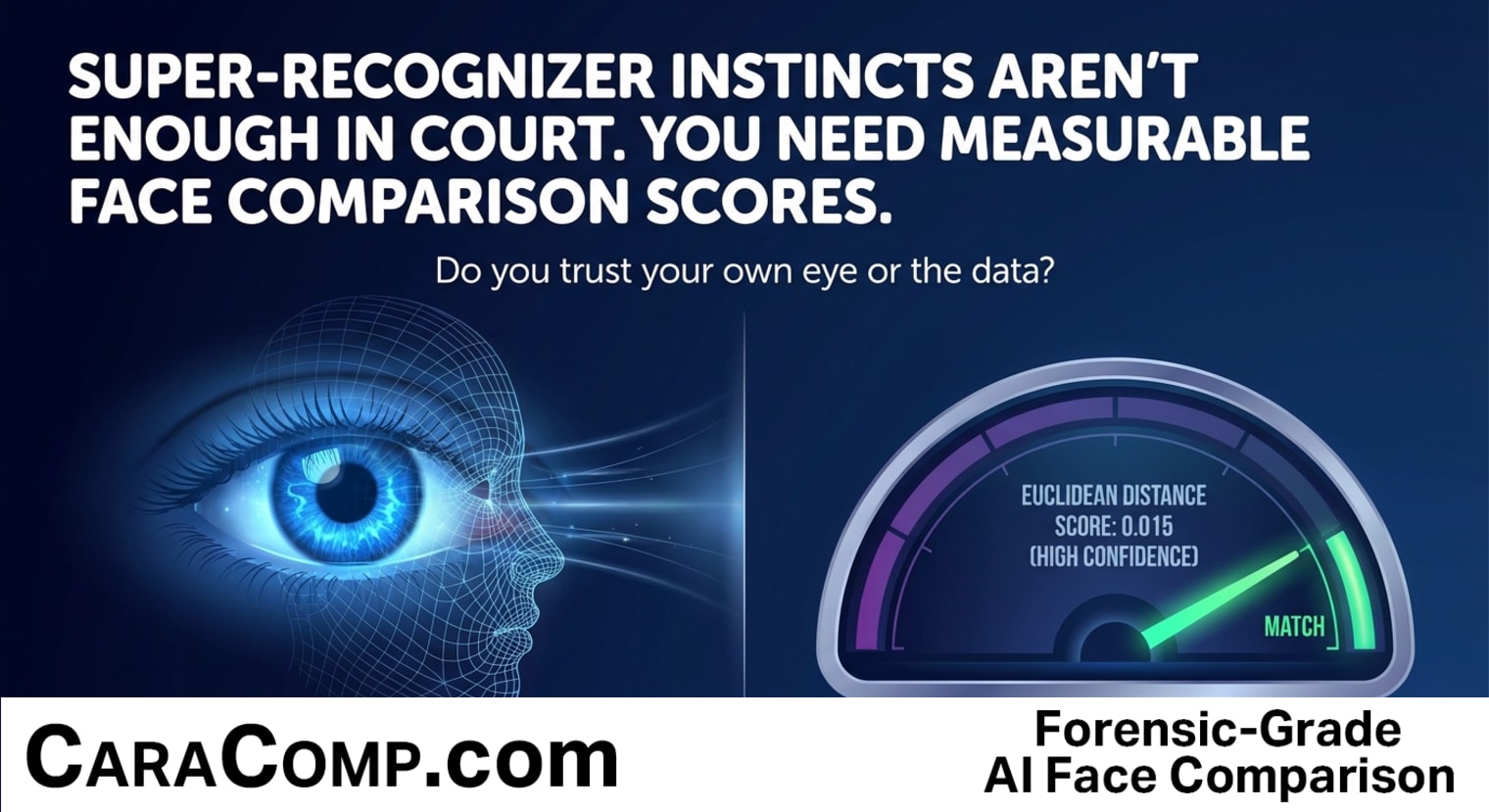
The human eye is capable of extraordinary feats, but for a tiny fraction of the population—roughly 1–2%—facial identification is a biological superpower fueled by a specific visual strategy: ignoring the hairline, ears, and outer contours to focus almost exclusively on the "internal facial triangle" of the eyes, nose, and mouth. These "super-recognizers" are increasingly sought after by elite agencies, yet they face a significant hurdle in the modern legal system. Because their talent is largely subconscious, they cannot fully articulate their methodology on the witness stand. In a professional or courtroom setting, a "hunch"—even a gifted one—is not evidence; it is a subjective opinion that can be easily challenged.
To turn a sharp professional observation into a defensible fact, investigators must bridge the gap between biological instinct and mathematical proof. This is where high-dimensional facial comparison becomes a solo investigator’s most powerful asset. By encoding a face into a mathematical vector and calculating the Euclidean distance between specific landmarks, we move from qualitative opinion to quantitative data. Whether you are a private investigator or a dedicated OSINT researcher, having access to these metrics ensures that your case analysis is not just accurate, but auditable, professional, and prepared for scrutiny.
- Biological expertise mirrors algorithmic logic: New research indicates that super-recognizers naturally focus on the same identity-stable regions—like the bridge of the nose and the interocular distance—that advanced facial comparison software weights most heavily during analysis.
- Instinct requires an audit trail for legal settings: While a seasoned investigator may feel certain that two photos show the same subject, a court-ready report requires documented confidence thresholds and numerical scores to survive rigorous cross-examination.
- The "Sommelier Effect" in investigation technology: Much like a wine expert uses chemical analysis to prove a vintage's authenticity, a professional investigator uses computational tools to corroborate their visual analysis, creating a dual-layered evidence package that is much harder to refute.
- Professionalism means embracing the "Inconclusive" result: True enterprise-grade tools provide the calibration necessary to identify when image quality or pose angles are too poor for a match, protecting your reputation from the risks of overconfidence.
For the modern investigator, the goal isn't to replace your experience, but to give your sharp eye the technical backbone it deserves. Combining your investigative intuition with precise Euclidean distance analysis transforms a subjective observation into a professional analysis that commands respect from clients and the courts alike.
Read the full article on CaraComp: Super-Recognizers Are Real — But Courts Need More Than a Good Eye


Comments
Post a Comment