NIST Benchmarks Are Impressive. Here's What They Don't Tell Investigators.
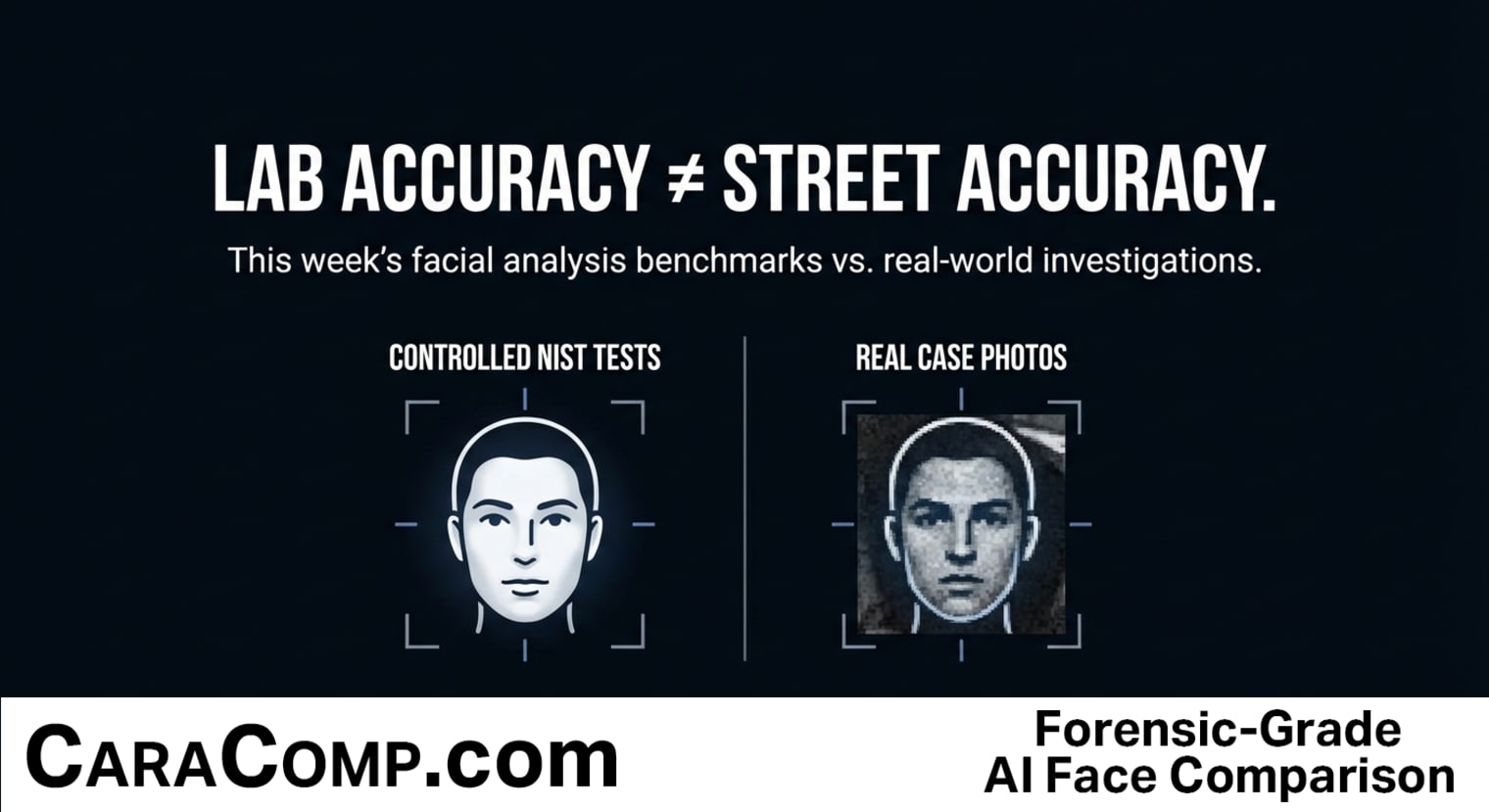
A leaderboard win in a laboratory is a vanity metric for software engineers, but for a private investigator working a insurance fraud case at 2:00 AM, it is a dangerous distraction from the reality of grainy pixels. This week’s buzz around the NIST facial analysis technology evaluations proves that algorithms are reaching near-perfection under controlled conditions. However, "perfect" in a lab doesn't close cases in the field when you are dealing with motion blur, poor lighting, and low-resolution exports.
The industry is currently celebrating firms that can estimate age within a three-year margin of error. While technically impressive, this technical milestone ignores the massive gap between enterprise-grade benchmarks and investigative reality. Most high-priced enterprise tools are optimized for government-scale datasets and six-figure budgets. They are built for the lab, not for the solo investigator who needs to perform a facial COMPARISON between a social media profile and a blurry CCTV frame without spending $2,400 a year on a subscription.
For the modern OSINT professional or PI, the goal isn't to have the most "academic" algorithm; it’s to have reliable Euclidean distance analysis that holds up in a professional environment. The current trend in the industry is to prioritize marginal gains in lab accuracy while ignoring the "Identity Gap"—the space where affordable, accessible tech meets the needs of small firms. When a tool is optimized for a benchmark rather than a user, the investigator loses. You don't need a tool that wins awards for age estimation; you need a tool that provides court-ready reports that can be defended in front of a client or a judge.
- Lab accuracy is a ceiling, not a floor. A high NIST ranking doesn't guarantee a match on a compressed doorbell camera video; it only proves the code works on high-quality, curated datasets.
- The "Enterprise Tax" is no longer justifiable. Small firms and solo PIs have been told for years that high-end facial comparison requires enterprise-level contracts, but the underlying science of Euclidean distance is now available at a fraction of the cost.
- Documentation trumps "Black Box" scores. As court admissibility standards tighten, investigators must move away from tools that offer a simple "yes/no" and toward systems that provide transparent, professional reporting.
Stop chasing lab-rated vanity metrics and start using technology built for the actual messiness of field investigations. The future of our industry isn't in the hands of the highest bidder—it's in the hands of the investigator who knows how to use enterprise-grade analysis without the enterprise price tag.
Read the full article on CaraComp: NIST Benchmarks Are Impressive. Here's What They Don't Tell Investigators.


Comments
Post a Comment