Multimodal Biometrics: Why Face + Fingerprint + Voice Defeats Deepfakes
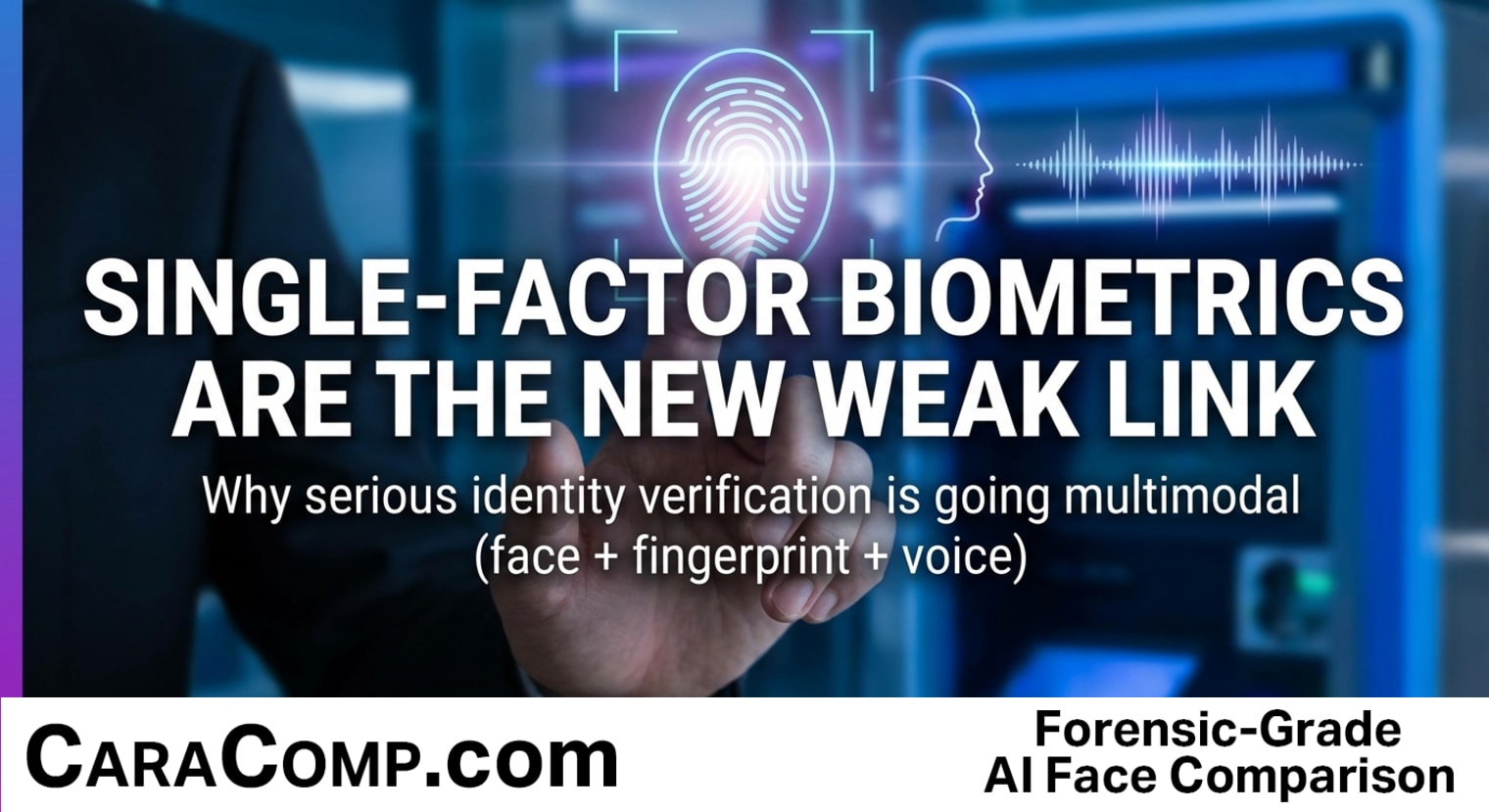
A $10 deepfake is all it takes to compromise a solo investigator's reputation in today's digital landscape. If you are still relying on a visual "gut feeling" or low-tier consumer search tools to identify a subject, you are effectively bringing a knife to a drone fight. The reality is that single-factor identification—relying solely on one facial image without mathematical verification—is becoming an investigative liability.
The math behind multimodal biometrics is brutal for fraudsters. While a standard facial match might offer a 1-in-1,000 confidence interval, layering fingerprint and voice data collapses the false acceptance rate to a staggering 1-in-100,000,000. For the private investigator or OSINT professional, this shift represents a line in the sand. You can no longer afford to present "looks like him" as professional evidence when the opposition can generate a convincing digital twin for the price of a sandwich.
At CaraComp, we see this evolution as a wake-up call for the industry. While enterprise-level multimodal systems are often locked behind $2,000/year contracts, the underlying principle of Euclidean distance analysis shouldn't be. Serious investigation technology must provide more than just a gallery of photos; it needs to deliver the same level of mathematical rigor used by federal agencies to distinguish a legitimate subject from a sophisticated spoof. Solo PIs and small firms are often squeezed out of this tech, yet they are the ones on the front lines where a false positive can end a career.
Key Implications for Modern Investigators:
- The "Visual Match" is No Longer Court-Defensible: As deepfakes become commodity tools, manual facial comparison is being viewed as subjective and unreliable. Investigators must adopt tools that provide Euclidean distance metrics to back up their findings.
- Affordability Gap is Closing: You don't need a nation-state budget to access enterprise-grade analysis. The shift toward specialized investigation technology means batch processing and court-ready reporting are finally accessible to solo practitioners.
- Liveness and Geometry are the New Benchmarks: Moving beyond simple recognition toward deep facial comparison allows investigators to identify subjects across disparate case photos with a level of precision that manual "eyeballing" simply cannot replicate.
The future of investigation isn't just about finding a face; it's about proving the match with such mathematical certainty that it survives the scrutiny of a modern courtroom. If your toolkit hasn't evolved to include automated facial comparison, you aren't just behind the curve—you're leaving yourself wide open to an AI-generated blindside.
Read the full article on CaraComp: Multimodal Biometrics: Why Face + Fingerprint + Voice Defeats Deepfakes


Comments
Post a Comment