How Facial Recognition Accuracy Is Really Measured — And Why It Matters
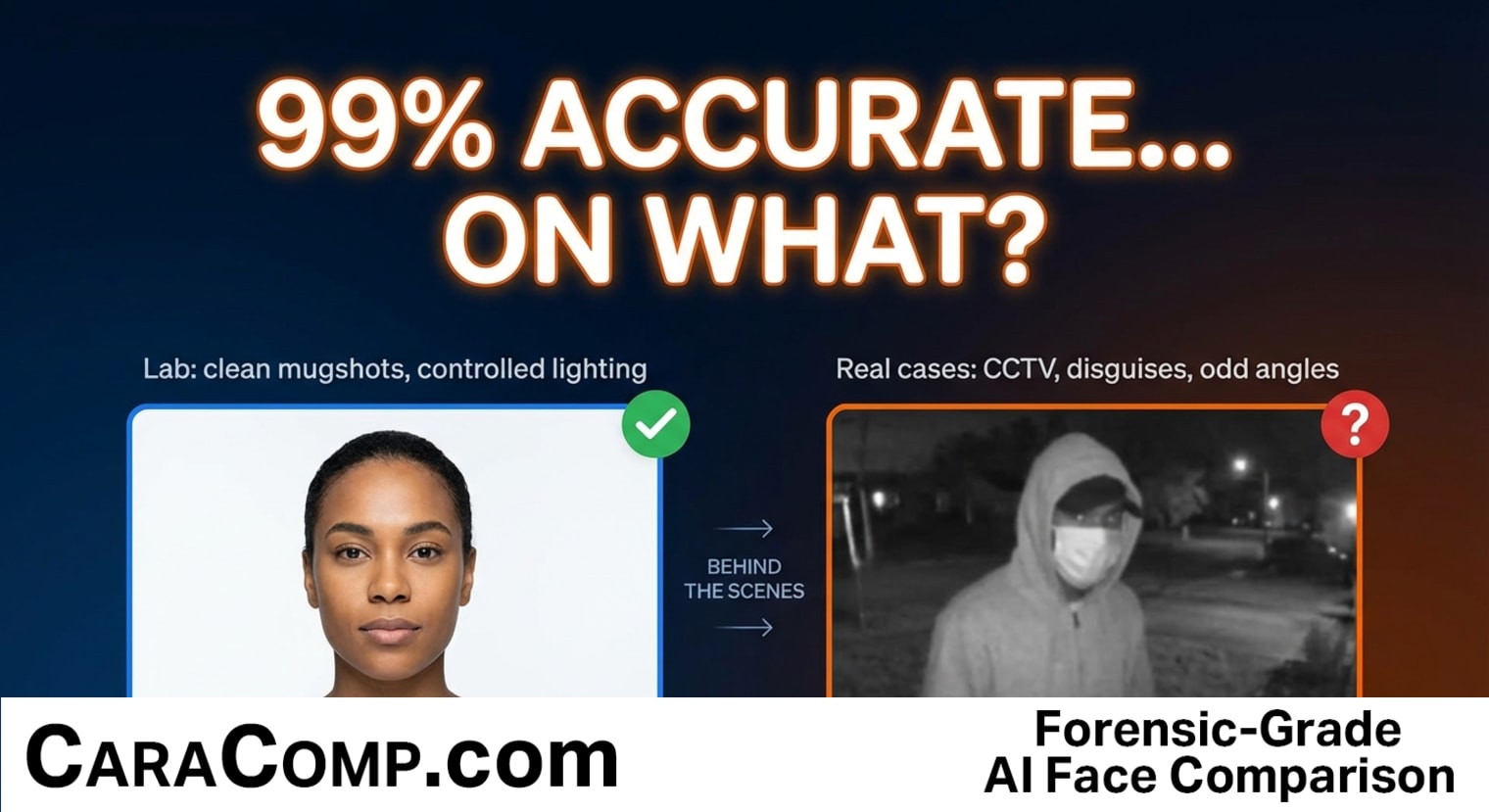
A "99% accuracy" claim from a technology vendor often says more about the lighting in a government laboratory than it does about the reliability of your actual case evidence. For a private investigator working a difficult case, a benchmark score earned on high-resolution, front-facing passport photos is practically meaningless when applied to a grainy, motion-blurred frame of surveillance footage. Understanding how these metrics are manipulated is essential for any professional who refuses to stake their reputation on a software's marketing department.
As investigators, we rarely deal with the "ideal" conditions found in the National Institute of Standards and Technology (NIST) testing environments. We deal with the "wild"—the shadows, the off-angle crops, and the digital noise of real-world investigation technology. When accuracy is presented as a single, static number, it hides the complex trade-offs that determine whether you find your subject or end up chasing a false lead. This article pulls back the curtain on how performance is truly measured and what those percentages cost you in the field.
- The "Wild" Performance Gap: While top-tier algorithms excel on clean mugshots, their accuracy can plummet by 30% to 40% when faced with real-world imagery such as compressed CCTV frames or subjects wearing hats and glasses.
- The Accuracy Threshold Dial: Accuracy is not a fixed score but a "dial" known as a match threshold; tightening the dial reduces false matches but simultaneously increases the risk of missing a genuine hit (a False Non-Match).
- Scale Multiplies Error: A 0.1% error rate might seem negligible in a one-to-one comparison, but when searching against a database of one million faces, that same error rate can generate 1,000 false candidates, making the results functionally unworkable for solo investigators.
- The Demographic Blind Spot: Independent testing consistently shows that algorithms can have error rates up to 100 times higher on specific demographic combinations than their advertised headline average.
Professional facial comparison requires more than just a software subscription; it requires an understanding of Euclidean distance analysis and the operational limits of the tools we use. By demanding to know the False Match Rate at a specific threshold, you move from being a passive user to a sharp, tech-savvy investigator who knows exactly how much weight to give a match in a court-ready report. Don't let a slide deck convince you that a lab-tested percentage is a substitute for field-tested reliability.
Read the full article on CaraComp: How Facial Recognition Accuracy Is Really Measured — And Why It Matters


Comments
Post a Comment