How Deepfake Detection Actually Works: It's All About Movement
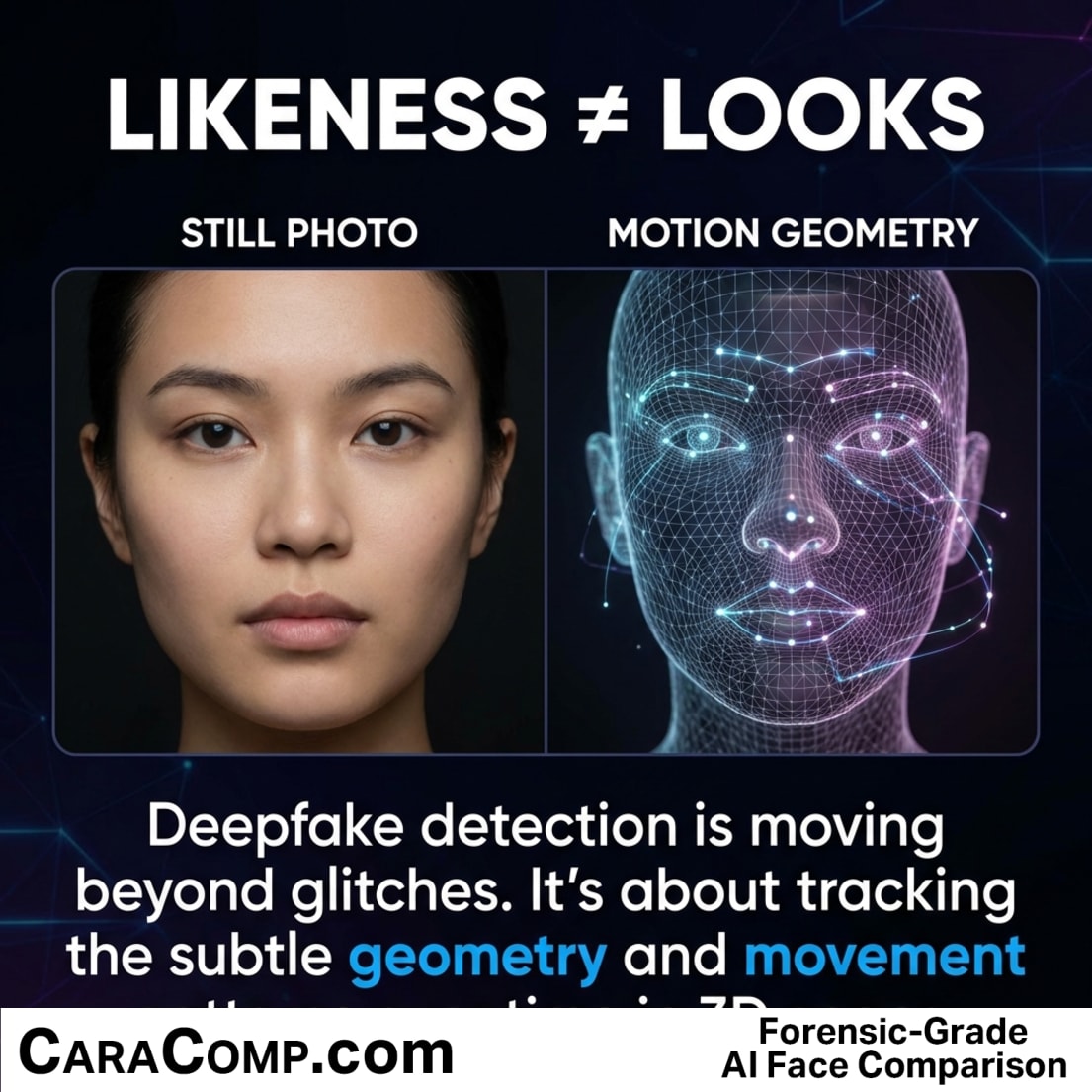
The era of the "glitchy" deepfake is dead, and if you’re still relying on your eyes to verify video evidence, you’re essentially guessing. Modern synthetic media has evolved past the point of visual "tells" like blurry teeth or flickering earlobes. Today’s sophisticated fakes pass the eye test with ease, which means investigators need to stop looking at what a face looks like and start measuring how it moves. The "vibe check" is no longer a professional standard; it's a liability.
As an investigator, your reputation rests on the reliability of your evidence. When a client or a court asks if a video is authentic, "it looks real to me" is a dangerous answer. The science of likeness detection has shifted from aesthetic analysis to high-dimensional mathematics—specifically, Euclidean distance analysis. By tracking dozens of facial landmarks across hundreds of frames, forensic systems can now identify a "behavioral signature" that is as unique to an individual as their fingerprint. If the math doesn't add up, the evidence doesn't hold up.
This isn't just a gimmick for tech giants or federal agencies with bottomless budgets. It is a fundamental shift in how OSINT and private investigators must approach digital evidence. While your brain "matches vibes," an algorithmic comparison engine calculates the precise geometric relationships between the corners of a mouth or the hinge of a jaw. This level of analysis used to be locked behind five-figure enterprise contracts, but the landscape has changed. Professional-grade facial comparison—the kind that stands up to scrutiny—is now a requirement for the modern toolkit.
The key for the sharp investigator is understanding that this isn't about mass surveillance; it’s about case-specific comparison. It’s about taking your photos and your video evidence and putting them through a rigorous, frame-by-frame geometric check. When you move from "eyeballing it" to "measuring it," you aren't just catching fakes—you're securing your professional standing as a tech-forward expert.
Key Implications for Investigators:- Manual visual review is a professional liability – Human perception is holistic and easily fooled by generative AI; mathematical landmark analysis is the only reliable way to verify consistency in a post-deepfake world.
- Movement is the new biometric anchor – While AI can replicate a face’s appearance, replicating the idiosyncratic micro-dynamics of how a specific person moves their facial muscles over 300+ frames is exponentially harder to spoof.
- Court-ready results require data, not intuition – Moving beyond simple recognition to detailed facial comparison allows investigators to present evidence based on Euclidean distance and geometric probability rather than subjective opinion.
The question for every solo PI and OSINT researcher is simple: are you still using your gut, or are you using geometry? The deepfake engineers are betting on the former. It's time to prove them wrong.
Read the full article on CaraComp: How Deepfake Detection Actually Works: It's All About Movement


Comments
Post a Comment