From Shaky CCTV Still to Court-Ready Lead: The Discipline Behind Facial Comparison
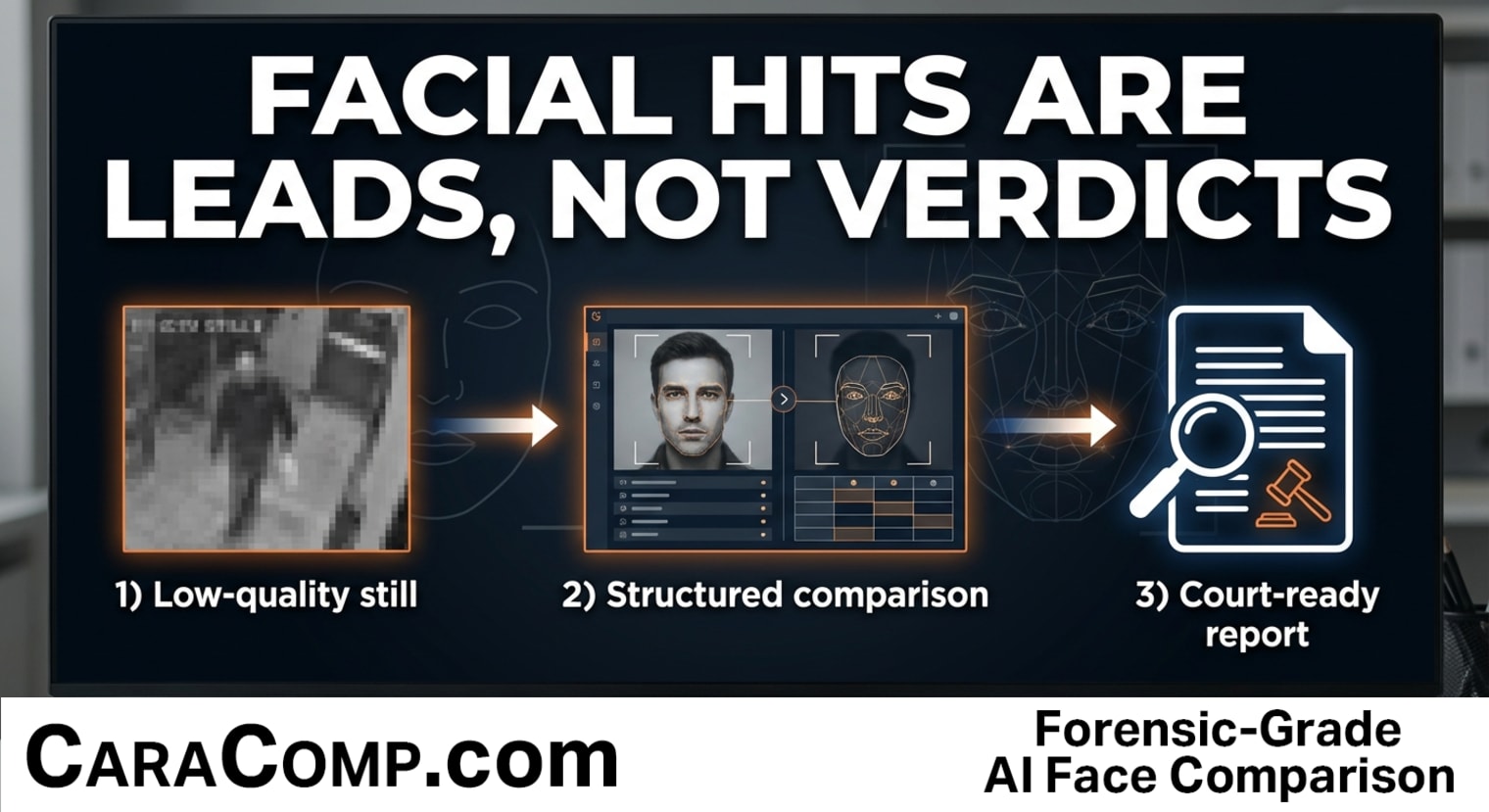
NIST research reveals that facial comparison accuracy doesn't just decline with poor image quality; it falls off a non-linear cliff once resolution drops below 90 pixels between the eyes. For the solo private investigator or OSINT professional, this means a grainy CCTV still is not a conclusion—it is a 128-dimensional math problem that requires disciplined methodology to become admissible evidence. Relying on a "confident-sounding" match without understanding the underlying math is one of the fastest ways to derail a professional reputation.
The transition from manual photo flipping to automated analysis is a significant leap in efficiency, but it requires a shift in mindset. Modern investigation technology doesn't "recognize" a person in the human sense; it calculates the Euclidean distance between numerical vectors representing facial geometry. At CaraComp, we provide this enterprise-grade Euclidean distance analysis to individual investigators at a fraction of the cost of government-level tools, ensuring that every "possible match" can be interrogated with scientific scrutiny. The goal is to move from a "hit" to a "lead" by following a structured, defensible process.
- The 128-Dimensional Vector: Modern facial comparison converts landmarks—such as pupillary separation, nasal bridge width, and jaw angles—into a complex numerical string. A match occurs when the Euclidean distance between two vectors falls below a specific threshold. Understanding that this is a mathematical probability rather than a binary "yes/no" is essential for presenting findings in court.
- The Hazard of the "Possible Match": The most significant risk in digital forensics is not a clear non-match, but the mid-range similarity score. This "zone of uncertainty" is where human confirmation bias is most likely to fill in the gaps of a low-quality image. Investigators must treat these hits as starting points for further corroboration rather than definitive proof.
- Dual-Method Feature Alignment: To survive cross-examination, professional methodology must combine algorithmic similarity scores with structured manual feature alignment. By documenting corresponding landmarks like ear morphology or philtrum length independently of the software's score, investigators create a dual-layered chain of evidence that catches errors either a human or a machine might miss in isolation.
- Source Quality Documentation: A court-ready report begins before the analysis even starts. Investigators must document the source image's inter-pupillary pixel distance and lighting conditions. If the source image is below the reliable 90-pixel threshold, that limitation must be explicitly noted to maintain the integrity of the evidentiary chain.
By adopting these forensic disciplines, solo PIs and small firms can leverage high-end investigation technology to close cases faster without sacrificing professional standards. The right tools allow you to perform batch comparisons across hundreds of photos in seconds, but the investigator’s methodology is what ultimately turns those seconds of analysis into a court-ready lead.
Read the full article on CaraComp: From Shaky CCTV Still to Court-Ready Lead: The Discipline Behind Facial Comparison


Comments
Post a Comment