From 27 Maybes to 3 Solid Leads: How Facial Comparison Triages a Case
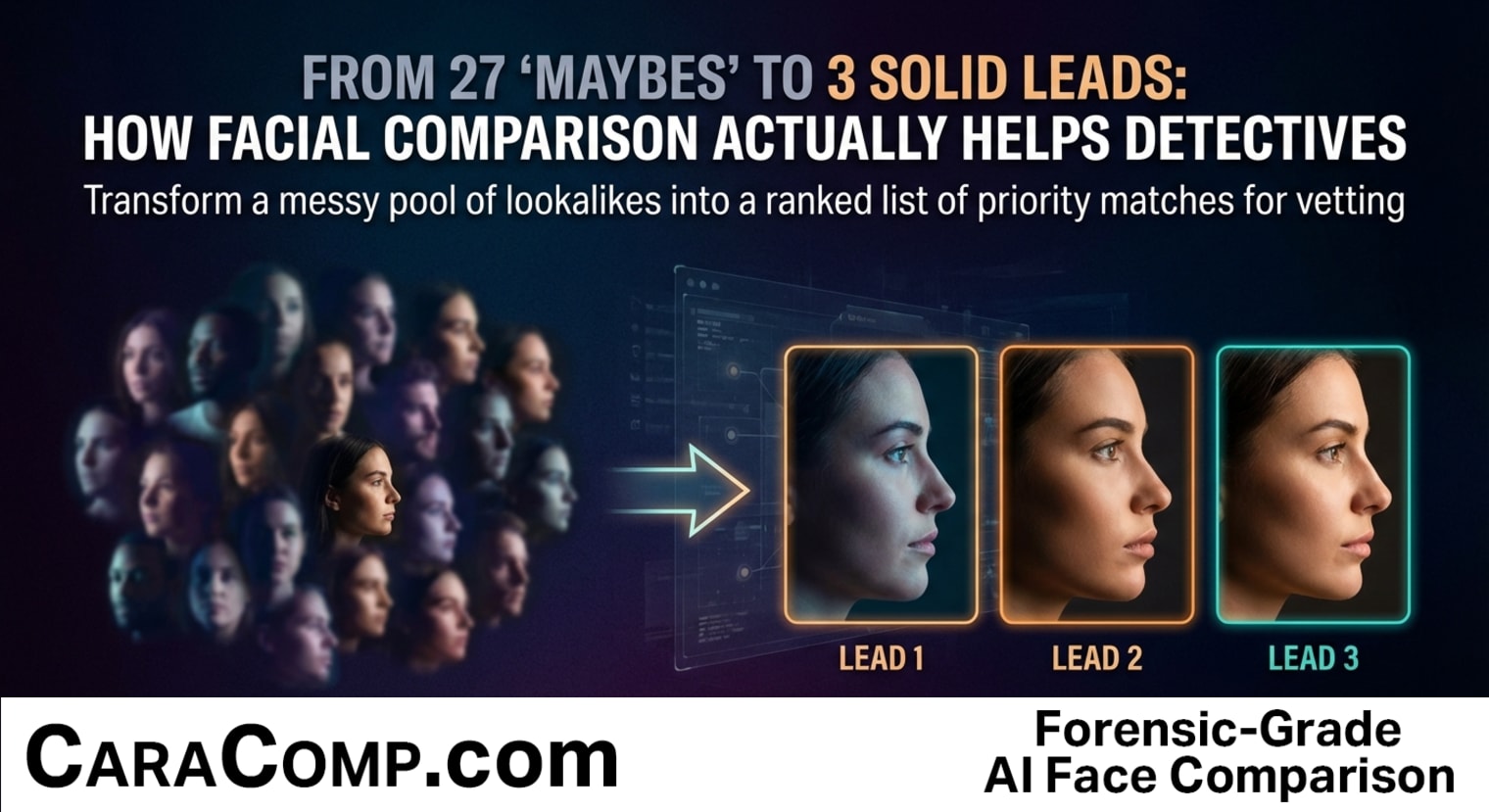
Research from the National Institute of Standards and Technology (NIST) confirms that human investigators start suffering from "confirmation bias" after reviewing just three or four candidates in a photo array. Once you mentally lock onto a potential match, your brain stops comparing the suspect to the original evidence and starts comparing them to your memory of the previous candidate. This isn't a lack of training; it's a structural failure of human cognition that puts every case at risk of a false positive or a missed lead.
The solution for modern investigators isn't to work harder; it's to change how they triage incoming data. Professional facial comparison technology doesn't replace the investigator's judgment—it mathematically organizes the chaos. By using Euclidean distance analysis, a system can rank a pool of dozens of potential faces based on geometric landmarks, ensuring that the investigator spends their high-value hours on the three most likely leads rather than twenty-four distractions. This shift from manual searching to mathematical triage transforms the investigative process from a subjective guess into a defensible methodology.
- Human cognitive anchoring is a major investigative liability. Manual review inevitably leads to fatigue and bias, whereas an algorithm maintains the same mathematical precision from the first comparison to the thousandth, effectively removing the "anchor effect" that plagues manual searches.
- Euclidean distance creates a ranked priority queue. Instead of a simple "yes/no" result, facial comparison produces a continuous similarity score, allowing investigators to focus limited resources on candidates that sit above a specific mathematical threshold.
- Geometric analysis overcomes human pattern bias. Modern algorithms map high-dimensional vectors of facial landmarks that the human eye might miss, such as subtle asymmetries in eye spacing or jaw geometry that remain consistent even across different camera angles.
- Ranked reporting is fundamentally more court-defensible. Documenting an investigative process based on mathematical similarity scores is far more robust under cross-examination than relying on an investigator's "gestalt judgment" or subjective intuition.
For solo investigators and small firms, having access to this level of analysis isn't just about speed—it's about reputation and accuracy. Using high-precision investigation technology ensures that your leads are backed by data, not just a gut feeling that might falter after hours of staring at grainy doorbell footage. Triage is the difference between chasing shadows and closing cases with confidence.
Read the full article on CaraComp: From 27 Maybes to 3 Solid Leads: How Facial Comparison Triages a Case


Comments
Post a Comment