Facial Recognition Is Heading to Court — Is Your Process Ready?
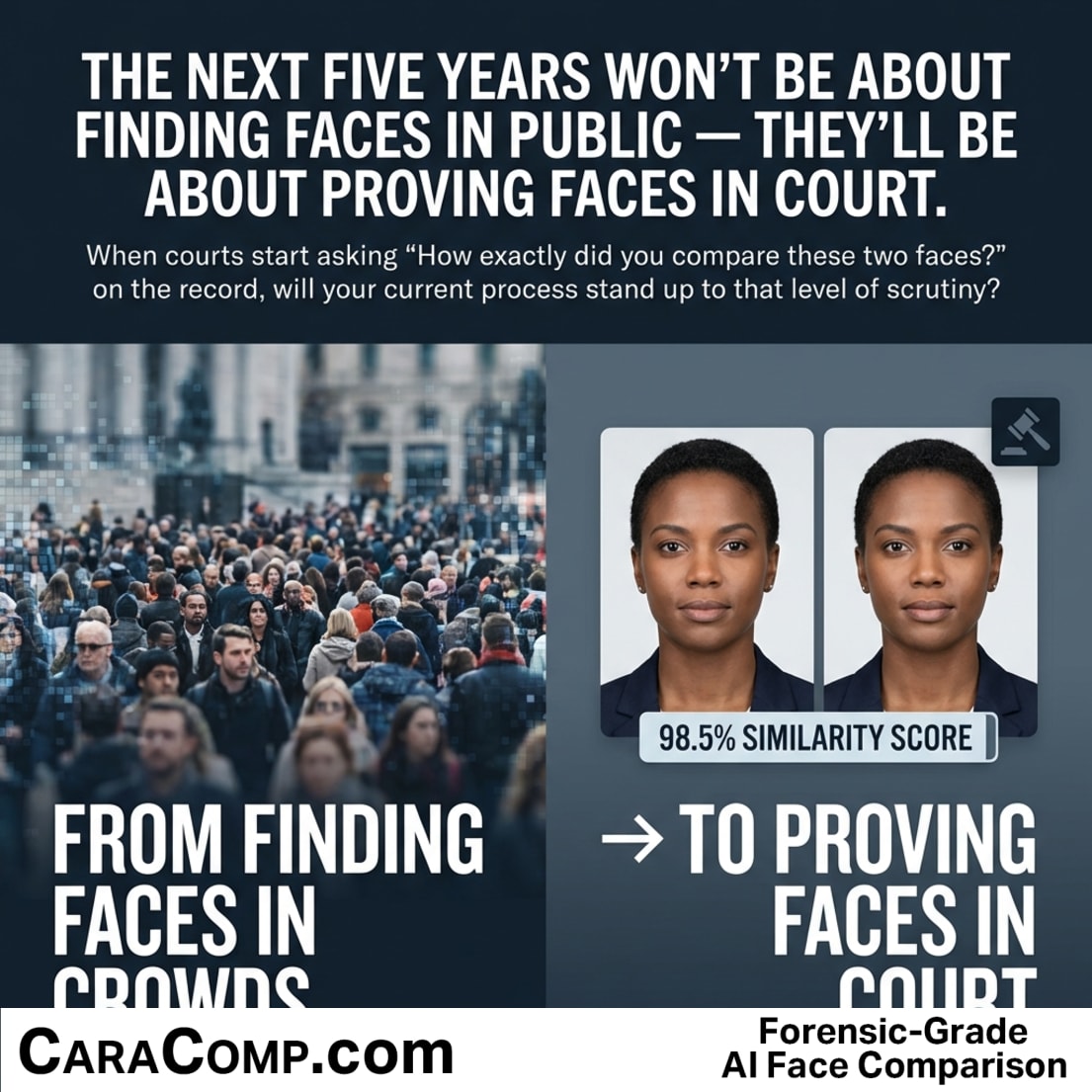
The New York State Bar Association is quietly building a wall around your evidence, and if you are still relying on "gut feelings" or unreliable consumer search apps to identify subjects, you are about to hit it at full speed. When one of the most influential legal bodies in the country begins scrutinizing biometric tech in entertainment venues, they aren't just worried about concerts. They are setting the stage for how facial analysis will be challenged in every deposition and trial for the next decade.
As an investigator, you need to understand that the era of "trust me, I'm an expert" is dying. Courts are no longer satisfied with an investigator saying two photos look like the same person. They want to see the math. Specifically, they are looking for a shift from facial recognition—the controversial scanning of crowds—to facial comparison, which is the scientific, side-by-side analysis of specific images. This distinction is the difference between a lead that holds up under cross-examination and evidence that gets tossed before the jury even sees it.
The problem for the solo private investigator or the small firm has always been the "gatekeeper" pricing of enterprise-grade tools. For years, the high-end Euclidean distance analysis required for court-ready results was locked behind five-figure contracts. This forced many pros to either spend hours on manual comparisons or, worse, risk their reputations on consumer-grade search tools known for false positives and zero professional reporting. That gap is where cases go to die. If you can’t show a reproducible, quantified similarity score, your methodology is a liability.
- Methodology is becoming more important than the match: A similarity score without a documented analytical process is just an opinion. Future-proof investigators are adopting tools that provide Euclidean distance analysis to ensure their findings meet the standard of forensic reproducibility.
- The "Comparison" loophole is your best defense: While public surveillance faces a regulatory squeeze, controlled facial comparison remains a standard investigative methodology. Framing your work as a scientific comparison between two known photos—rather than a "big brother" search—protects your workflow from privacy-related legal challenges.
- Enterprise tech is finally affordable for the solo PI: The tech gap is closing. You no longer need a federal agency's budget to access batch processing and professional reporting. Modern investigators are pivoting to lean, powerful platforms that provide the same analytical depth as enterprise tools at a fraction of the cost.
If you aren't upgrading your workflow to include court-ready reporting and quantified analysis now, you are essentially waiting for a defense attorney to prove you’re behind the curve. In the modern courtroom, being "tech-savvy" isn't a bonus; it’s a requirement for survival.
Read the full article on CaraComp: Facial Recognition Is Heading to Court — Is Your Process Ready?


Comments
Post a Comment