Deepfake on Your Desk: How Smart Investigators Use Face Comparison as a First-Pass Filter
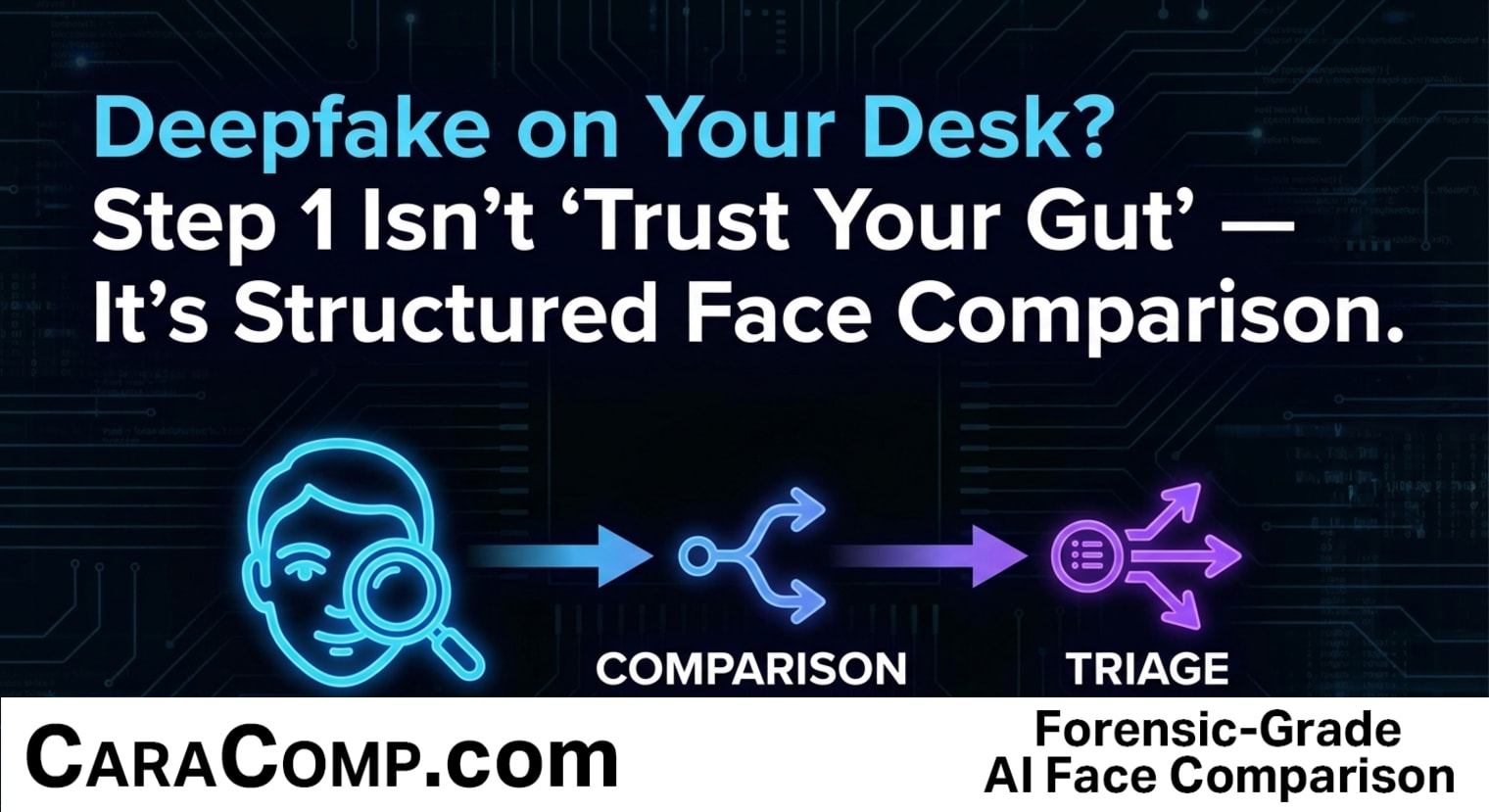
If you’re still relying on your "investigator’s intuition" to spot a deepfake, you might as well flip a coin and go home. Human beings—including trained detectives—correctly identify synthetic videos only about 55% of the time. In a professional field where your reputation is your only currency, those are career-ending odds. When a client drops a "smoking gun" video on your desk, your first move shouldn't be a gut check; it should be a technical triage.
The rise of personalized fraud at scale means investigators are being buried under a mountain of digital media. You can no longer afford to spend three hours manually side-eyeing photos to see if the earlobes match. More importantly, you shouldn't have to pay $2,000 a year for enterprise-grade software just to get a reliable result. Smart investigation technology is finally trickling down to the solo PI, moving facial comparison from a "luxury agency" tool to a standard operating procedure for every case.
At CaraComp, we see facial comparison as the "ER triage" of modern OSINT. It isn't about scanning crowds or surveillance; it’s about taking YOUR case photos and running them through Euclidean distance analysis to find the mathematical truth. Is the subject in the video actually your target, or a high-tech mask mapped onto a stranger? By measuring the geometric relationships between facial landmarks—the distance between pupils, the ratio of the jawline—you get a baseline similarity score that holds up under scrutiny. This allows you to route your investigation toward the right forensic tools immediately, rather than wasting billable hours on a fabrication.
- Professional Credibility: Transitioning from "it looks like him" to "the Euclidean distance analysis shows a 94% match" changes the conversation with clients and legal counsel, providing a court-ready foundation for your findings.
- Operational Efficiency: Batch processing allows you to compare dozens of faces across a case in seconds, ensuring you never miss a critical match simply because you were too busy to look at every frame.
- Economic Survival: With the volume of synthetic media growing by 900% annually, investigators using manual methods will simply be priced out of the market by those leveraging affordable, high-precision comparison tools.
The investigators who survive the next five years won't be the ones with the best "hunches." They’ll be the ones who integrate structured facial comparison as their first-pass filter, ensuring every case they close is backed by data, not a coin flip.
Read the full article on CaraComp: Deepfake on Your Desk: How Smart Investigators Use Face Comparison as a First-Pass Filter


Comments
Post a Comment