Deepfake Calls Surge as Governments Bet on Biometric Verification
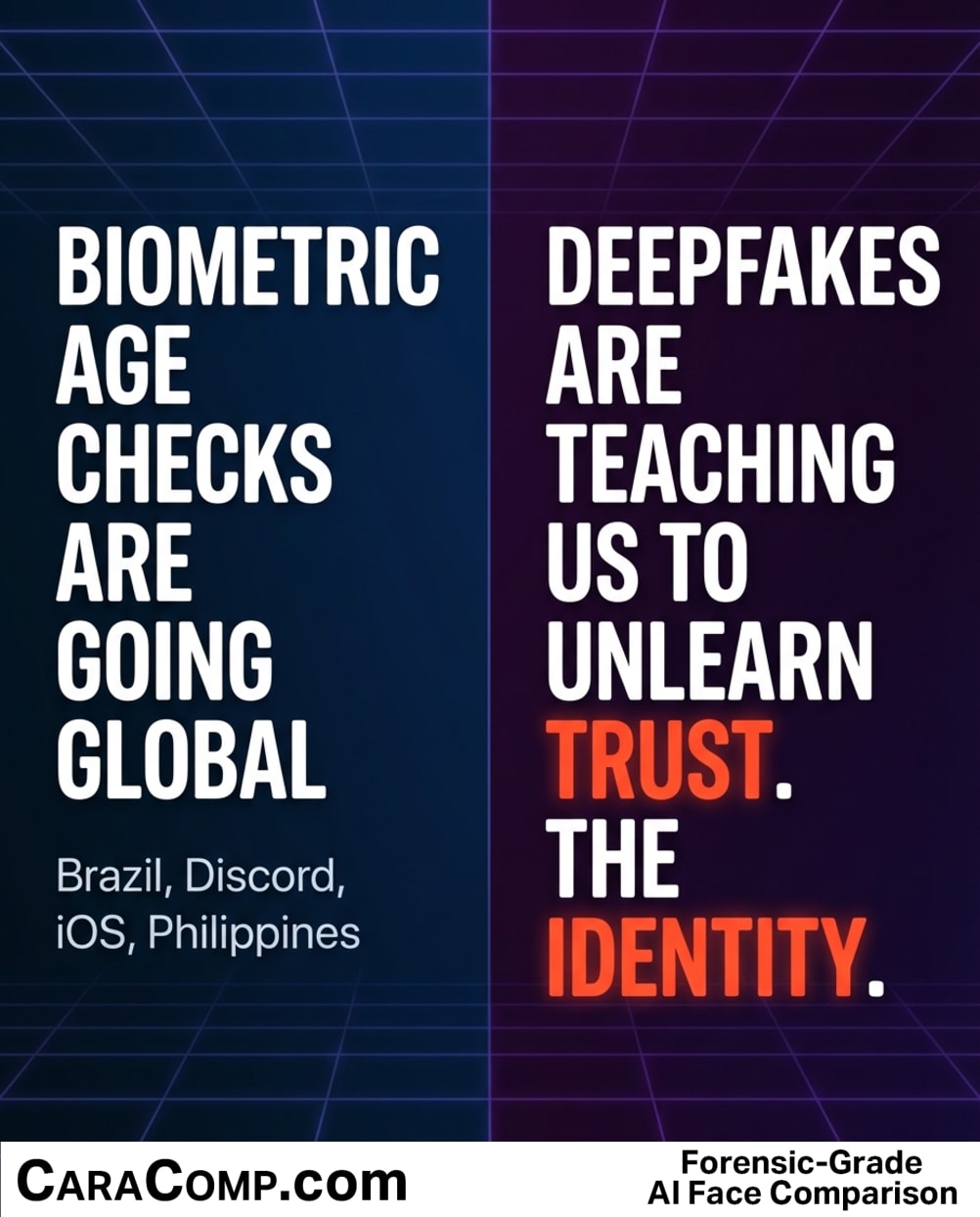
Governments are handing fraudsters a skeleton key by mandating biometric verification at the exact moment deepfakes have become indistinguishable from reality. While Brazil, the Philippines, and major social platforms rush to enforce facial "proof-of-life" checks, they are ignoring a devastating reality: deepfake fraud attempts against these very systems have surged 58% year-on-year. For the solo investigator, this isn't just a tech trend—it is a professional liability shift that makes manual facial comparison a dangerous relic of the past.
The "unlearn trust" movement isn't just for families avoiding phone scams; it is a directive for OSINT professionals and private investigators. When a biometric gate is defeated by synthetic media, the fallout doesn't land on the software developer—it lands in your case file. If you are still relying on "gut feeling" or spending three hours manually squinting at grainy photos to confirm a subject's identity, you are already behind. In a landscape where liveness checks are being bypassed by generative AI, your evidence must be backed by the same mathematical precision used by federal agencies.
This is where the identity gap becomes a crisis. Solo PIs and small firms are often priced out of enterprise-grade tools, forced to choose between five-figure annual contracts or unreliable consumer search engines that offer no forensic reporting. To maintain a reputation for closing cases, investigators need affordable, professional-grade Euclidean distance analysis. You need to be able to upload a batch of photos and receive a court-ready report that proves a match based on data, not just an opinion that a defense attorney can shred.
- The "Verified" Trap: Mandatory biometric mandates are creating a false sense of security; investigators must now treat "verified" digital identities as high-risk data points requiring independent forensic validation.
- Euclidean Distance is the New Standard: As deepfakes improve, manual visual comparison is no longer court-admissible in the eyes of savvy clients. Professional investigators must adopt batch-processing tools that provide mathematical certainty.
- Affordability vs. Reliability: The surge in synthetic fraud means solo PIs can no longer rely on 2-star consumer tools or "free" searches; enterprise-caliber analysis at a fraction of the cost is now a baseline requirement for survival.
The forensic reality is clear: as governments mandate more biometric data, the burden of proof falls on the investigator to verify the verifier. Don't let your case be the one that fails because you relied on an outdated process in a deepfake world.
Read the full article on CaraComp: Deepfake Calls Surge as Governments Bet on Biometric Verification


Comments
Post a Comment