Clear ≠ Real: Why High-Res Faces Can Still Be Fake
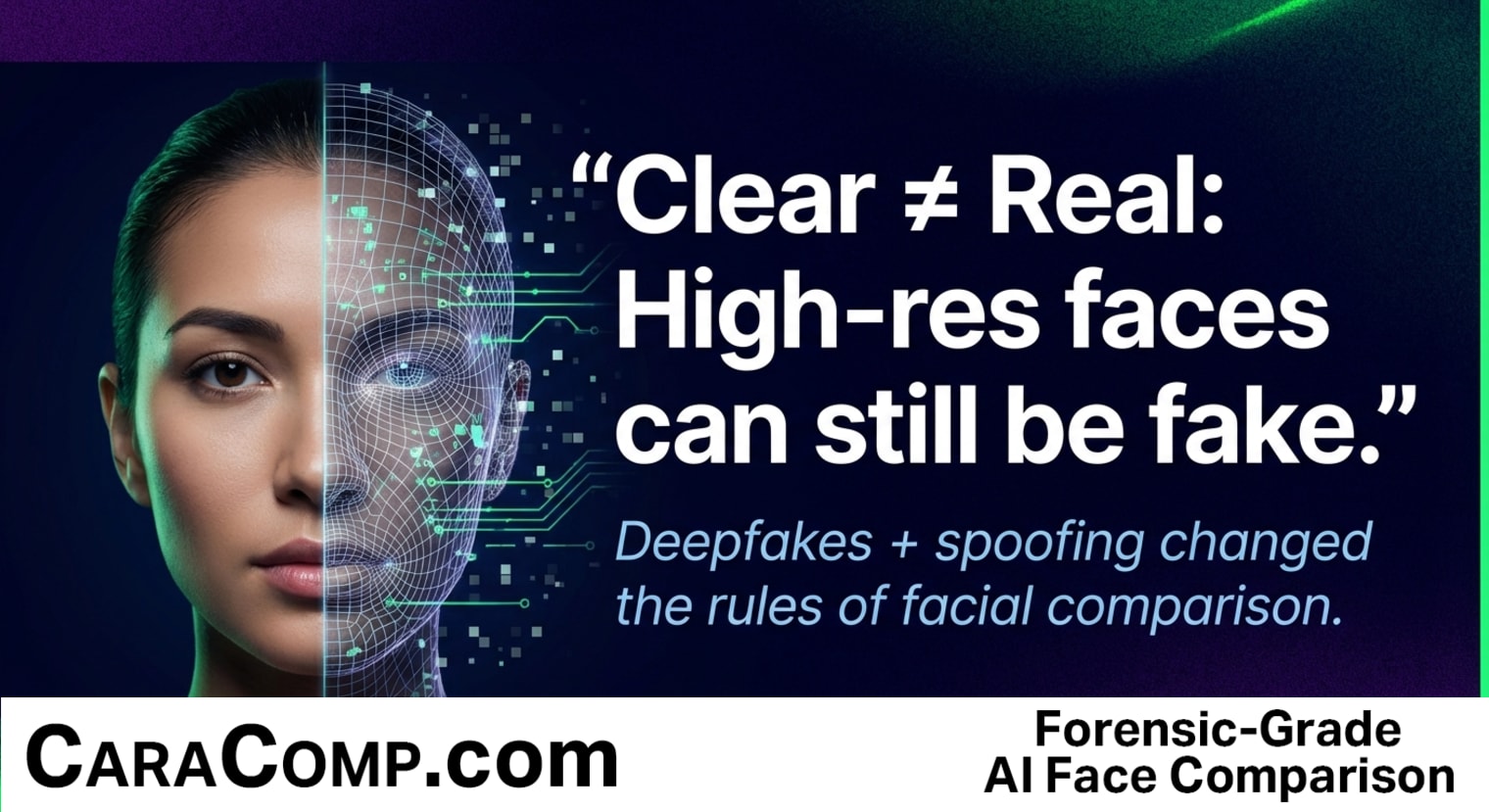
A suspiciously perfect face in a suspect image pulled from a social platform isn't a green light—it's a red flag. While many investigators are trained to prioritize high-resolution imagery for facial comparison, modern generative AI has turned that logic on its head. In the field of professional investigation, a pristine, high-res image often indicates a synthetic creation rather than a legitimate piece of evidence. Real-world captures from CCTV or witness mobile devices are almost never perfect; they contain grain, motion blur, and lighting inconsistencies that AI-generated faces lack.
For the solo private investigator or OSINT researcher, falling for the "clarity myth" can lead to catastrophic case failures. When an image is too clean, it often bypasses the mental filters we use to verify authenticity. This creates a dangerous identity gap where an investigator might stake their reputation on a Tier 3 synthetic spoof. To maintain an edge, professionals must shift their focus from surface appearance to the underlying structural geometry of the face. By utilizing Euclidean distance analysis, investigators can look past the pixels to measure the mathematical ratios that remain consistent across authentic images, regardless of the resolution or source.
- The 704% Deepfake Surge: Face-swap attacks increased by over seven hundred percent in just six months during late 2023, making presentation attack detection (PAD) a mandatory prerequisite for any reliable facial comparison workflow.
- Compression as a Mask: Social media platforms aggressively recompress images, which effectively "scrubs" the digital artifacts and blending seams that would otherwise betray a deepfake, leaving investigators with a clean but fraudulent image.
- Structure Over Appearance: Enterprise-grade investigation requires moving beyond how a face looks and focusing on structural geometry—measuring landmark-to-landmark ratios like inter-ocular distance and jaw angles that are far harder to spoof than surface skin textures.
- The ISO/IEC 30107-3 Standard: Authenticity is now categorized into three escalating tiers of spoofing—printed photos, 3D masks, and fully synthetic AI—requiring a methodology that verifies the source chain and facial architecture before a match is confirmed.
Modern investigation technology allows solo PIs to implement these sophisticated checks without needing a government-sized budget. By focusing on batch processing and structural analysis, you can ensure your results are court-ready and professionally vetted. It is no longer enough to simply see a face; you must be able to mathematically verify the identity within the frame to protect your case and your credibility.
Read the full article on CaraComp: Clear ≠ Real: Why High-Res Faces Can Still Be Fake


Comments
Post a Comment