AI Face Match ≠ Probable Cause: A Grandmother Paid the Price
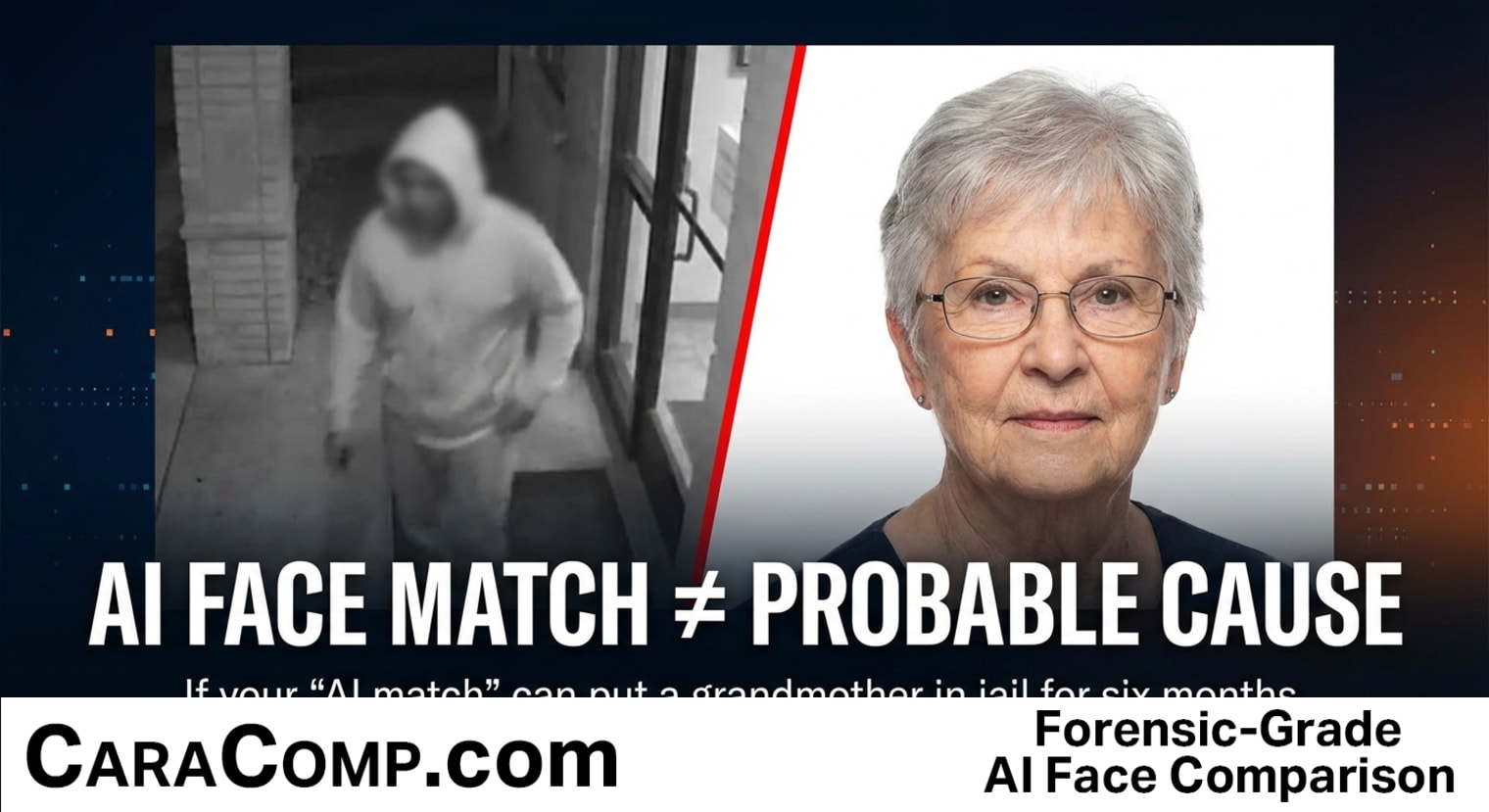
Six months of a Tennessee grandmother’s life were erased because an investigator mistook a software suggestion for a forensic fact. This wasn’t a "glitch" or a "rogue algorithm"—it was a textbook case of confirmation bias disguised as technology. When police in North Dakota used facial comparison on grainy bank footage and "confirmed" the match by glancing at a driver’s license, they didn’t solve a crime; they rationalized a mistake.
For the solo private investigator or the small firm professional, this story is a loud warning. Facial comparison technology is a powerhouse for narrowing down suspects and verifying identities across thousands of photos in seconds, but it is an investigative lead, not a conclusion. Using enterprise-grade Euclidean distance analysis—the kind once reserved for federal agencies but now accessible to any tech-forward investigator—requires a commitment to methodology. You cannot treat a high-tech match with the same casualness as a "wanted" poster.
The real failure here was the circular verification. A detective looking at a social media profile to "confirm" a hit is just building an echo chamber. True investigative power comes from using high-fidelity tools to generate a similarity score, then backing that up with independent, court-ready reporting. You don’t need a $2,000-a-year enterprise contract to get this right, but you do need to move beyond unreliable consumer search tools that lack professional rigor and carry abysmal reliability ratings.
As OSINT professionals and PIs, our reputation is our only currency. If you stake a case on a match from a tool that doesn't provide batch processing or professional analysis, you aren't just risking the case; you're risking your career. The goal isn't just to find a face—it's to provide an analysis that holds up under the hottest lights.
- The "Lead vs. Evidence" Gap – Facial comparison is the ultimate tool for generating leads and narrowing a field of thousands, but it is never a substitute for independent corroboration. Professional investigators use Euclidean distance to point the way, then build the case through traditional OSINT and financial records.
- The Danger of Consumer-Grade Tools – Relying on "free" or cheap consumer search tools with low reliability scores is a liability. Solo PIs need enterprise-caliber analysis and professional reporting to ensure their results stand up to the scrutiny of clients and the legal system.
- Methodology Over Muscle – Having the best tech in the world doesn't matter if the investigator's process is flawed. The future belongs to those who combine advanced comparison software with a rigorous, evidence-first approach that avoids the trap of confirmation bias.
The future of investigation belongs to those who adopt the best tech without losing the sharp instincts of a veteran detective. Don’t let a tool do your thinking—let it do your heavy lifting while you provide the professional oversight your clients expect.
Read the full article on CaraComp: AI Face Match ≠ Probable Cause: A Grandmother Paid the Price


Comments
Post a Comment