"AI Age Verified" in a Case File Means Less Than You Think — Here's the Math
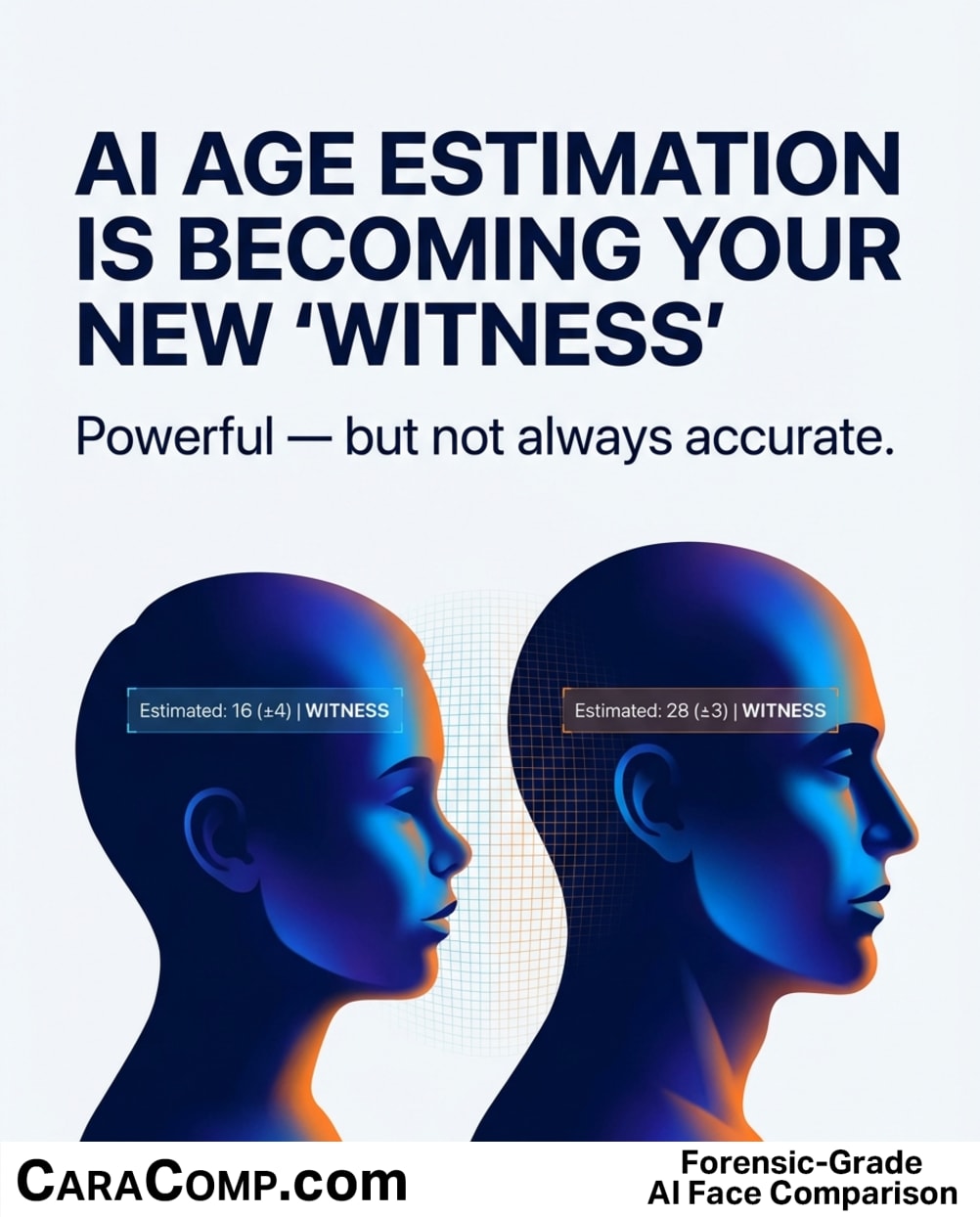
Stop trusting the "Age Verified" label in your case files. That 0.01% error rate touted by major platforms sounds like near-perfection, but run that math across a platform with 450 million users and you’ve just handed 45,000 people a "confirmed" age that is mathematically wrong. For a private investigator or OSINT professional, that isn’t a rounding error—it’s a professional liability waiting to explode during a deposition.
The industry is currently obsessed with Facial Age Estimation (FAE), but there is a massive gap between what the technology does and what investigators believe it does. When a KYC log or social media platform stamps a profile as "verified," they aren't looking at a birth certificate or a government database. They are running a statistical inference based on visual aging indicators. They are guessing. If you’re a solo PI or a fraud examiner relying on these automated "verified" tags to build a case, you’re building on sand.
At CaraComp, we see this tech-gap daily. Most investigators are forced to choose between consumer-grade search tools with abysmal reliability or enterprise-grade software that costs $2,000 a year. This "middle ground" of age estimation is particularly dangerous because it masks probability as certainty. Real facial comparison requires Euclidean distance analysis—the same math used by federal agencies—to determine if two faces are the same, not just a guess about how many wrinkles are around someone's eyes.
- Probability is not proof: An AI "verification" is actually a probability range. If a system says a subject is 23, it’s actually saying there is a statistical likelihood they fall between 20 and 28. Staking your reputation on that "23" is a high-stakes gamble.
- Environment kills accuracy: Low resolution and poor lighting don't just make a photo look bad; they flatten the textural signals the algorithm depends on. In the field, you rarely get the "perfect" lighting required for these estimates to be even remotely reliable.
- The "Verified" Trap: "Age verified by AI" in a compliance log simply means a range cleared a threshold. It does not mean an identity was confirmed. Investigators must distinguish between biometric estimation and biometric identification.
The forward-looking investigator doesn't just look for a "green checkmark" on a profile. You need the ability to run your own batch comparisons and generate court-ready reports that show the actual math behind the match. Don't let a platform's "near-perfect" estimate become the weak link in your next investigation.
Read the full article on CaraComp: "AI Age Verified" in a Case File Means Less Than You Think — Here's the Math


Comments
Post a Comment