Age Checks Now Read Your Face — But That Still Doesn't Prove Who You Are
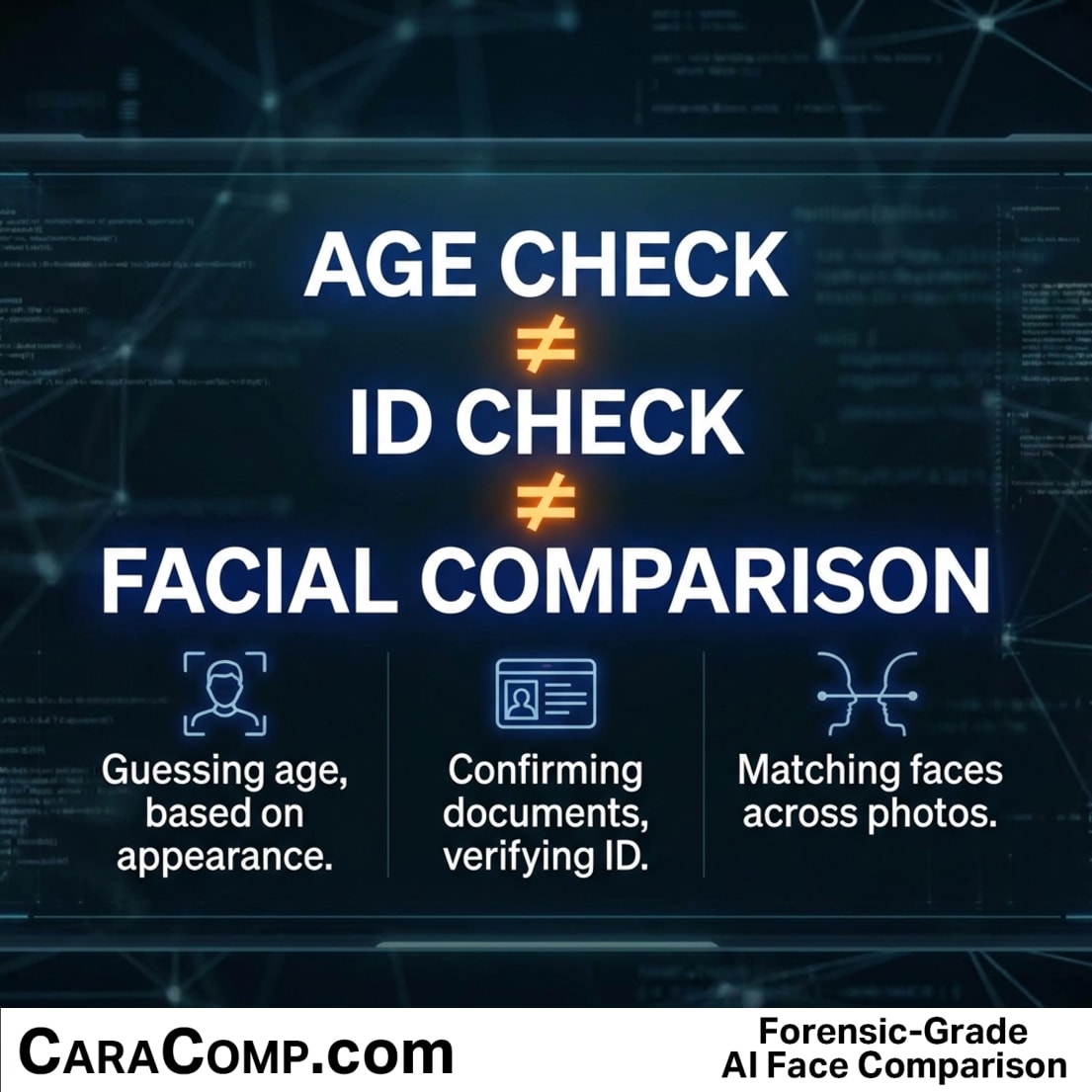
Your next major case could collapse in court because a prosecutor or a lazy investigator mistook a "wrinkle scan" for a positive identification. As biometric age estimation explodes across the web—fueled by the UK’s Online Safety Act and similar global mandates—the industry is hurtling toward a massive evidentiary crisis. Platforms are now using neural networks to guess a user’s age within 1.22 years, but here is the cold truth for the investigative community: a "pass" on an age gate is not a match in a file.
The distinction between age estimation and facial comparison is the difference between a bouncer’s gut feeling and a forensic lab’s DNA report. Age estimation tools are designed for privacy; they are built to avoid knowing who a person is. They scan skin texture, jaw definition, and nasolabial folds to output a probability score. For a solo investigator or an OSINT researcher, relying on these logs as "proof" of identity is a career-ending move. This technology is optimized for regression—predicting a number—while professional investigations require classification and side-by-side Euclidean distance analysis.
At CaraComp, we see the danger in this "biometric blurring." When investigators lack access to affordable, enterprise-grade comparison tools, they start grabbing at whatever data is available, including unreliable age-check logs. This creates a dangerous "Identity Gap" where the tools meant to protect children on social media are being misinterpreted as forensic evidence. Real investigation requires comparing YOUR case photos using rigorous mathematical distance analysis, not relying on a platform’s temporary pixel-pattern guess that was discarded seconds after the user logged in.
- The False Positive Trap: Age estimation systems are notoriously susceptible to environmental factors like lighting and makeup, meaning an "identity" tied to these checks is built on a foundation of sand.
- The Privacy Paradox: Because these systems are designed to be "privacy-preserving" by not storing data, they lack the audit trails required for court-admissible facial comparison.
- The Professional Standard: Investigators must move away from consumer-grade "estimation" and adopt dedicated comparison tech that provides side-by-side forensic reporting to survive cross-examination.
The surge in biometric age gates is a win for platform safety, but a potential minefield for the legal system. If you aren't using professional-grade comparison software to verify your subjects, you aren't doing an investigation—you're making a guess.
Read the full article on CaraComp: Age Checks Now Read Your Face — But That Still Doesn't Prove Who You Are


Comments
Post a Comment