A Perfect Face Match Used to Close Cases. In 2026, It Signals Deepfake Risk.
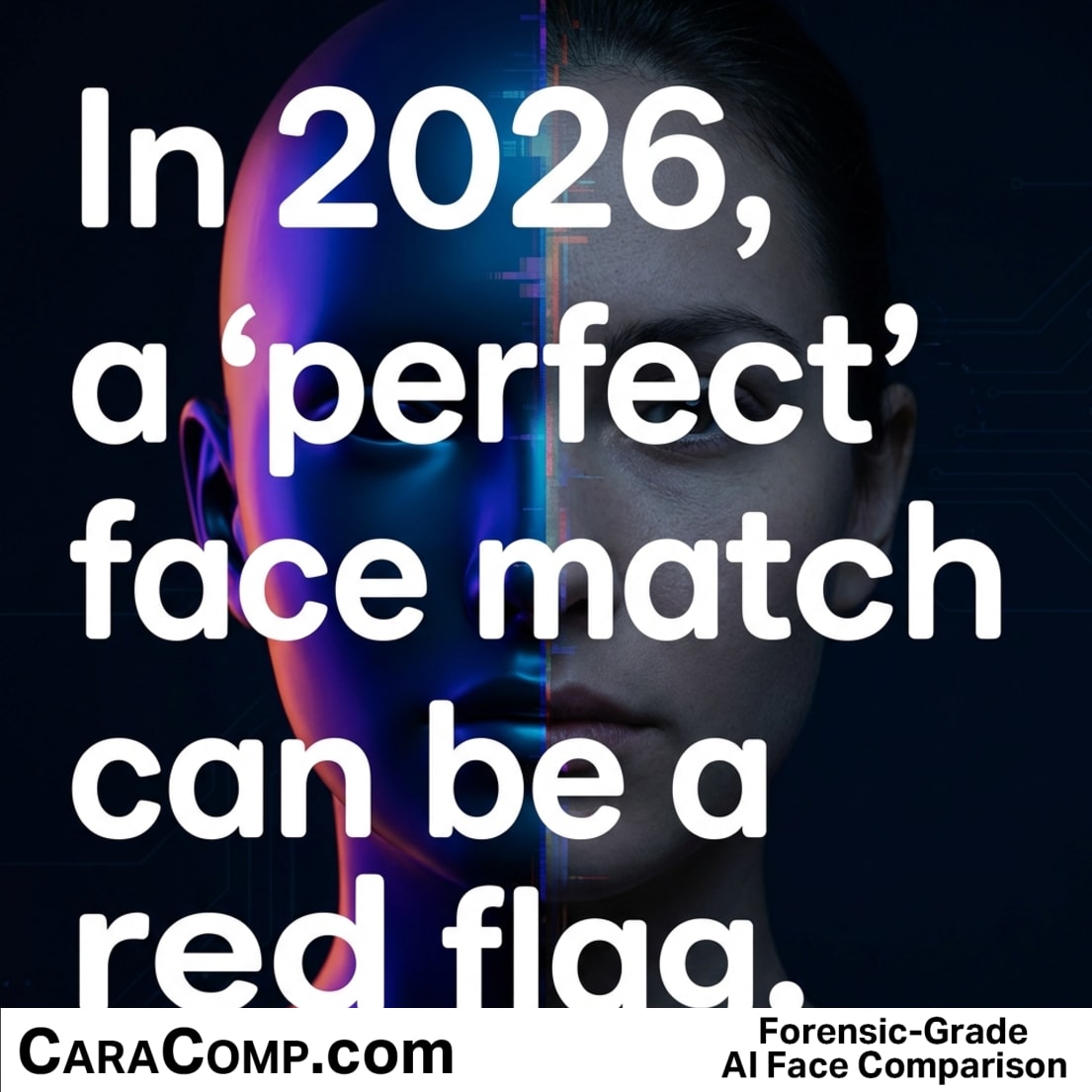
If you are still staking your professional reputation on the fact that two faces "look the same," you are one deepfake away from a catastrophic case failure. By 2026, a flawless facial match shouldn't be the moment you celebrate; it should be the moment you start sweating. In the age of synthetic media, visual perfection is no longer evidence of identity—it is a massive red flag.
The statistics are harrowing for any investigator who relies on manual comparison or low-tier consumer tools. Current research indicates that 99.9% of humans cannot accurately detect high-quality AI-generated deepfakes. For a solo private investigator or a small SIU firm, this isn't just a technical curiosity; it’s a professional liability. Deepfakes are specifically engineered to pass visual inspection by being "too clean," smoothing out the natural noise and micro-irregularities that exist in authentic photography. If your workflow doesn't include a layer of mathematical verification, you aren't investigating—you're guessing.
This is where the industry must pivot from casual "recognition" to rigorous facial comparison. At CaraComp, we’ve seen that the only way to defeat a synthetic "perfect match" is to move beneath the pixels. We focus on Euclidean distance analysis—measuring the precise mathematical relationships between facial landmarks. While a deepfake might fool the human eye by looking smooth and consistent, it often fails the rigorous geometric tests that calculate the spatial reality of a subject's features. A "perfect" visual match that lacks a corresponding geometric signature is a hallmark of fraud.
- The "Smoothing" Trap: Deepfakes often lack the natural compression artifacts and skin-pore irregularities of real photos. A match that looks "too good to be true" usually is.
- Euclidean Distance is Non-Negotiable: To present results in court, you need more than a side-by-side photo; you need a defensible mathematical report that proves a match based on spatial geometry, not just visual similarity.
- Reputational Risk: With 1 in 5 biometric fraud attempts now involving synthetic media, investigators using outdated manual methods are leaving themselves wide open to being discredited by tech-savvy defense attorneys.
The era of the "gut feeling" in facial identification is over. Solo investigators no longer have to choose between being behind the curve or paying $2,400 a year for enterprise-level software. You need the same caliber of analysis used by federal agencies to ensure your matches are litigation-proof, without the "big brother" price tag. If you aren't measuring the math, you aren't seeing the whole picture.
Read the full article on CaraComp: A Perfect Face Match Used to Close Cases. In 2026, It Signals Deepfake Risk.


Comments
Post a Comment