A 3mm Error Breaks Your Match: What 3D Facial Landmarks Do Before the Score Appears
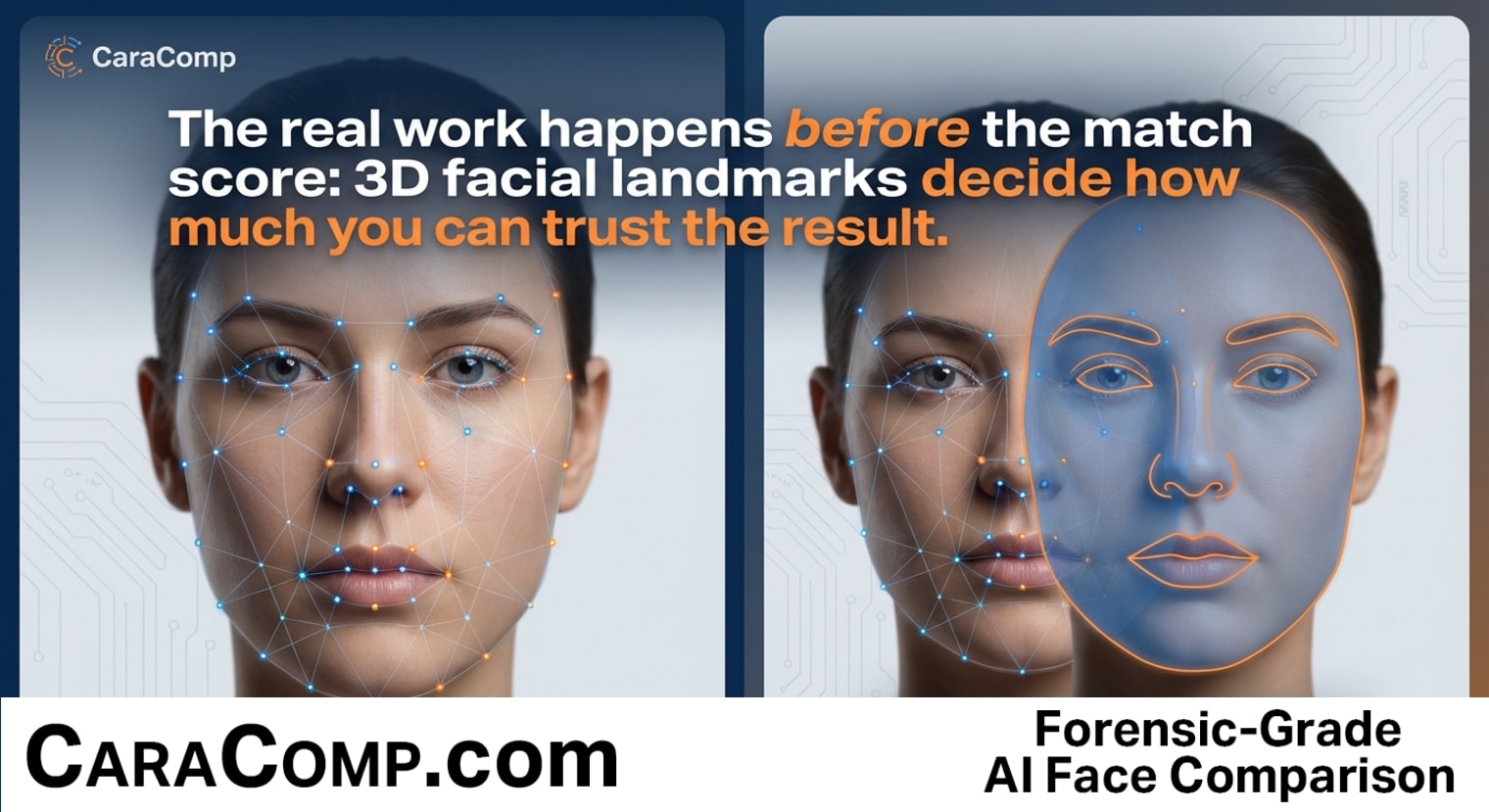
That 95% confidence score on your latest facial comparison report might be a total hallucination. While most investigators are busy celebrating a high-percentage "hit," the real pros know that the score is the most dangerous piece of data in the room if you don’t understand the geometry behind it. A mere 3mm error in landmark placement—the distance of a couple of pennies stacked together—is enough to turn a "positive match" into a professional liability.
Recent breakthroughs in 3D facial landmark detection, specifically the CF-GAT model, are proving what we at CaraComp have championed for years: texture is a lie, but geometry is the truth. Most budget tools rely on 2D texture maps—essentially trying to identify a person by the "paint" on their face. When lighting shifts or an investigator is forced to work with grainy CCTV footage at a difficult angle, those 2D systems wobble. They misplace the anchor points on the tear ducts or the corner of the mouth, yet they still spit out a high confidence score based on flawed math.
For the solo private investigator or the OSINT researcher, this isn't just a technical quirk; it’s a credibility crisis. If you’re presenting a report to a client or preparing for a deposition, you cannot stake your reputation on an algorithm that missed the subalar point by 8mm because of a shadow. You need Euclidean distance analysis that understands the underlying 3D structure of the human face, regardless of whether the subject is squinting or standing under a fluorescent bulb.
- Confidence scores are downstream from landmark accuracy — if the 60–100 anatomical anchor points aren't perfectly placed, the final percentage is structurally compromised.
- 3D curvature is the new fingerprint — moving away from 2D texture maps toward geometric "point clouds" allows for reliable comparison even when dealing with poor lighting and non-frontal angles.
- Manual comparison is a legacy risk — spending hours eyeballing photos is no longer a "thorough" methodology; it is a recipe for missing the subtle geometric variances that enterprise-grade AI catches in seconds.
The industry is moving toward high-fidelity, geometry-driven analysis. Investigators who continue to rely on "good enough" consumer tools or manual visual checks are essentially guessing while their tech-savvy peers are proving. Stop looking at the score and start looking at the foundation.
Read the full article on CaraComp: A 3mm Error Breaks Your Match: What 3D Facial Landmarks Do Before the Score Appears


Comments
Post a Comment