A 0.78 Match Score on a Fake Face: How Facial Geometry Stops Deepfake Wire Scams
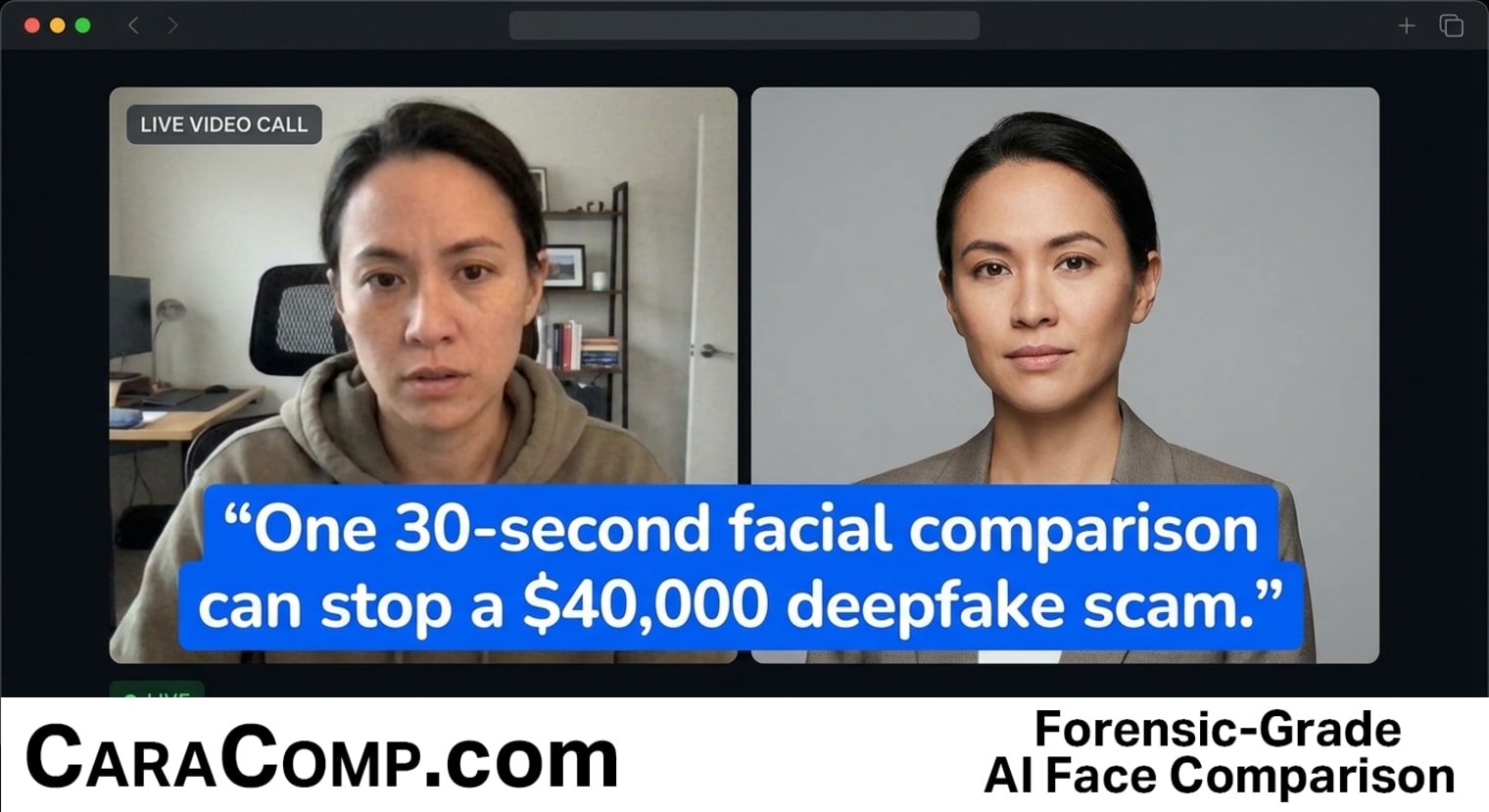
A $25.6 million wire transfer didn’t vanish because of a technical glitch or a weak password—it vanished because a finance employee trusted their own eyes. When a "CFO" appears on a live video call, sounds like the boss, and moves like the boss, human biology dictates we believe the evidence. But in an age where live-mapped deepfakes can turn a basement-dwelling scammer into a corporate executive in real time, "seeing is believing" has become a professional liability for investigators and fraud analysts.
The hard truth is that human intuition is currently losing the arms race against generative AI. We are wired for facial recognition—a fast, emotional process—but we are historically terrible at facial verification. Scammers are now hiring "AI models" to sit on camera while software overlays a target’s face with terrifying precision. To catch this, investigators must stop looking for "glitches" and start looking at the math. This is where Euclidean distance analysis changes the game.
For the solo private investigator or the small firm handling insurance fraud, the shift from manual comparison to geometric measurement isn't just a luxury; it’s a requirement for survival. When you convert a face into a 128-point vector, you aren't looking at a person anymore—you’re looking at a list of coordinates. If the distance between those points and a known reference photo returns a score of 0.78, the "CFO" on the screen is a mathematical impossibility, no matter how convincing the performance. At CaraComp, we believe this enterprise-grade analysis shouldn't be gated behind five-figure government contracts.
Key implications for the investigative industry:
- Biological trust is a security hole: Human investigators can no longer rely on visual "gut feelings" to verify identity in digital evidence; mathematical Euclidean distance is the only objective standard left.
- The "sideways glance" test is obsolete: As deepfake models improve, traditional manual detection methods are failing, making automated facial comparison tools essential for modern case analysis.
- Affordability dictates capability: High-level forensic tools must move into the hands of solo PIs and small firms to prevent a two-tier justice system where only the largest agencies can spot a synthetic fraud.
The gap between "this looks real" and "this is real" is where the most dangerous fraud lives. By stripping away the emotional narrative of a video call and focusing on the underlying geometry, investigators can provide court-ready certainty that bypasses the limitations of the human eye. In this new landscape, the sharpest tool in your kit isn't your experience—it's the math you use to back it up.
Read the full article on CaraComp: A 0.78 Match Score on a Fake Face: How Facial Geometry Stops Deepfake Wire Scams


Comments
Post a Comment