$58.3B in Synthetic Fraud Warns Investigators: "I Eyeballed It" Won't Hold Up Much Longer
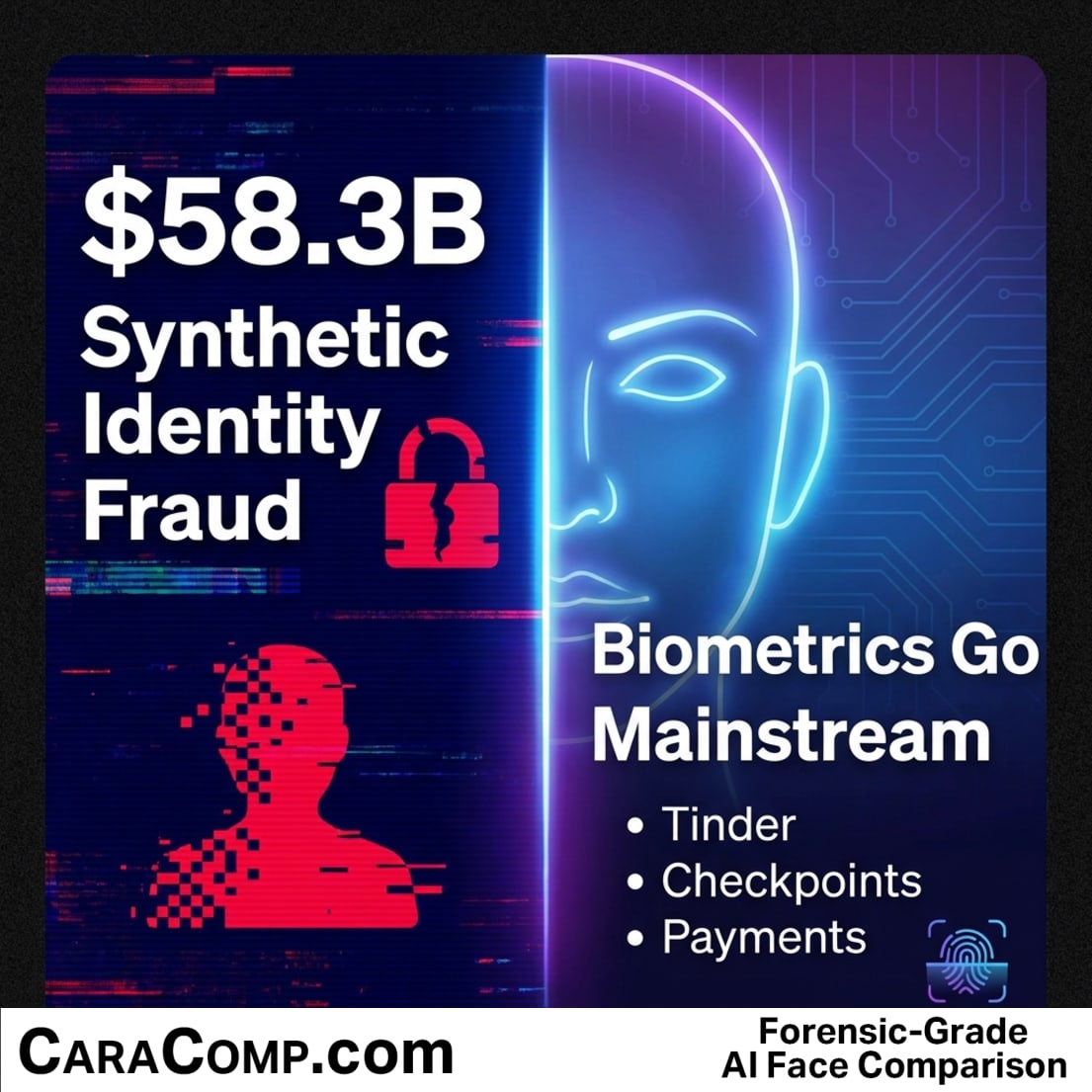
Your eyes are lying to you, and it is about to cost your clients billions. Synthetic identity fraud is projected to explode to $58.3 billion by 2030, a staggering 153% surge that effectively signals the death of manual facial comparison. If your primary tool for identifying a subject is a side-by-side visual "gut check," you are bringing a magnifying glass to a drone fight. The era of "eyeballing it" isn't just ending; it’s already a professional liability.
Deepfakes now power one in five biometric fraud attempts. This isn't just background noise for big banks—it is a direct threat to the credibility of every solo private investigator and OSINT researcher. When a convincing deepfake identity package can be purchased on the underground market for $5, the barrier to entry for fraudsters has vanished. This creates a methodology crisis: how do you testify to a match in court when industry analysts admit they can no longer distinguish AI-generated faces from real ones with the naked eye? Relying on human perception in a world of algorithmic deception is a recipe for a tossed-out case.
For the professional investigator, this shift requires a move away from subjective "looks like" analysis toward objective, technical comparison. High-level fraud requires high-level verification. While enterprise-grade tools have historically been locked behind five-figure price tags, the necessity for Euclidean distance analysis—measuring the mathematical relationship between facial features—has become the new baseline for evidence that actually sticks.
- Visual "Eyeballing" is Now a Legal Liability: Presenting a manual comparison in a professional report invites devastating cross-examination. If your methodology doesn't include algorithmic confidence scores, you're guessing, not investigating.
- The Credibility Gap is Widening: When banking institutions and border checkpoints move to multi-layered biometric verification, clients will soon stop paying for the "intuition" of an investigator who refuses to use modern comparison tech.
- Synthetic Identities Break Traditional OSINT: Confirming two photos match proves nothing if the face in both images was AI-generated from the start. Only documented, reproducible analysis can separate a real subject from a digital ghost.
The industry is moving toward a standard where "I compared these photos" is no longer an acceptable answer. To stay ahead of the $58 billion fraud curve, investigators must leverage the same math-based comparison tools used by the elite agencies, or risk their reputation on a methodology that became obsolete 18 months ago.
Read the full article on CaraComp: $58.3B in Synthetic Fraud Warns Investigators: "I Eyeballed It" Won't Hold Up Much Longer


Comments
Post a Comment