Your Family's Faces Are 128 Numbers — And Someone Else Has Them
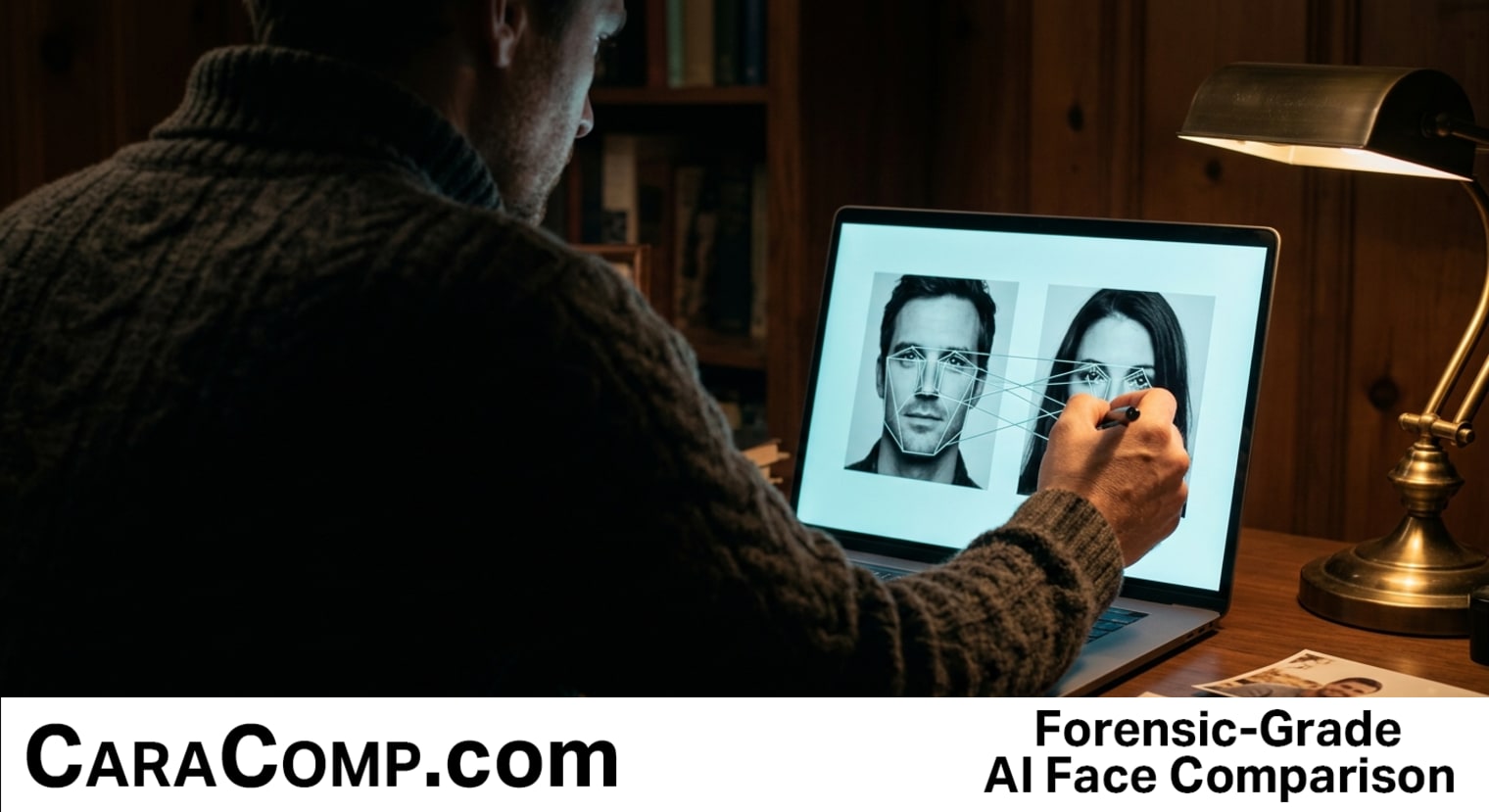
Your face is being liquidated into a string of 128 integers, and if you are an investigator still comparing photos manually, you are working harder than the algorithms that have already replaced your workflow. The industry secret that enterprise software providers don’t want you to know is that facial comparison isn’t magic—it is basic geometry. Every subject in your case file is effectively a mathematical coordinate in a 128-dimensional space, and the only thing standing between you and a closed case is the ability to calculate the distance between those points.
For years, this level of Euclidean distance analysis was gatekept by companies demanding five-figure annual contracts and federal-level oversight. They sold the "mystery" of AI to justify astronomical price tags. But the math has changed. As facial comparison moves from expensive cloud-based surveillance to localized, high-speed analysis, the professional private investigator finally has the upper hand. You don't need a government server farm to determine if the person in the 2024 insurance claim is the same individual from a 2018 social media post; you just need the right math running on your own terms.
This shift represents a massive democratization of investigative power. When we strip away the "big brother" mysticism, we are left with a clinical, court-ready tool that treats facial features as data points. This is standard investigative methodology, not a science fiction trope. By focusing on facial comparison rather than mass-scale scanning, the modern investigator avoids the ethical quagmires of the cloud while maintaining the technical edge necessary to compete with large-scale firms.
- The death of manual comparison: Spending three hours squinting at jawlines is no longer "thorough"—it is a liability. Euclidean distance analysis provides a mathematical certainty that human eyes simply cannot replicate under fatigue.
- Affordability is the new industry standard: The tech used to cost 23 times more than it does today. Investigators who refuse to adopt affordable, localized comparison tools are essentially paying a "legacy tax" to stay slower than their competition.
- Professionalism through reporting: Converting a face into 128 numbers allows for objective, data-driven reporting that holds up in court, moving investigations away from "gut feelings" toward admissible biometric evidence.
The question for the modern investigator is no longer whether this technology works—the math is settled. The question is whether you will continue to pay an enterprise premium for a process that should be as standard and affordable as your skip-tracing tools. Stop guessing and start measuring.
Read the full article on CaraComp: Your Family's Faces Are 128 Numbers — And Someone Else Has Them


Comments
Post a Comment